4 days in Philadelphia 10/24- 10/27/2024
| Day 1 Arrival/Dinner |
Day 2 Walking around Cocktail/Tuna Bar |
Day 3 Guided Tour Dinner at Amata |
Day 4 LibertyBell/Independence Hall City Center |
Day 3- Guided Tour-10/26/2024
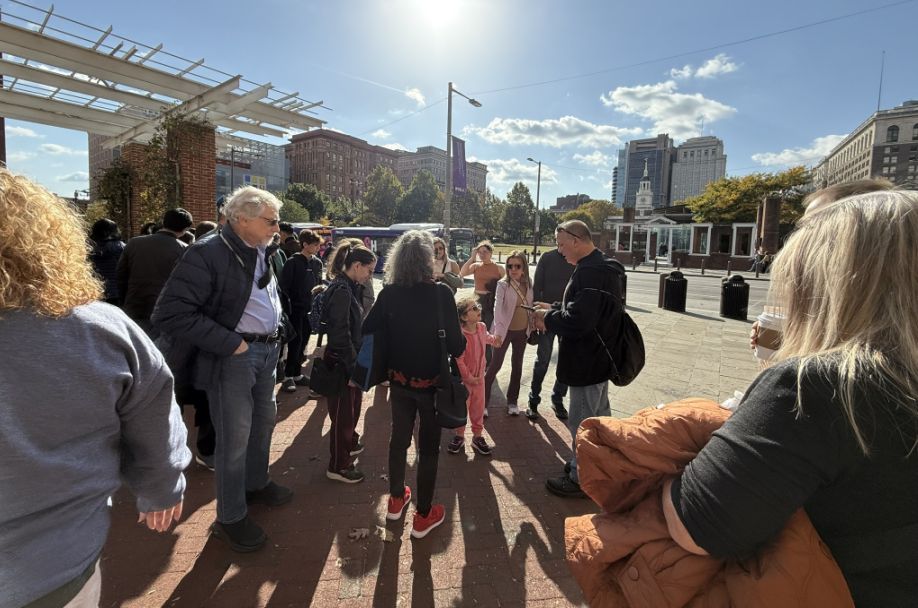
Today we are taking a guided 2 hour tour about "Revolution and the Founders: History Tour of Philadelphia", and we will walk you through the core sites of America’s founding of the Independence Hall where the Declaration of Independence and the Constitution were debated and adopted, the grounds where the Continental Congress met, the Site of the President's house, and the area around the Liberty Bell. It’s a compact area geographically, but historically enormous.
Meeting with our tour guide at the Independence Visitor Center.
 |
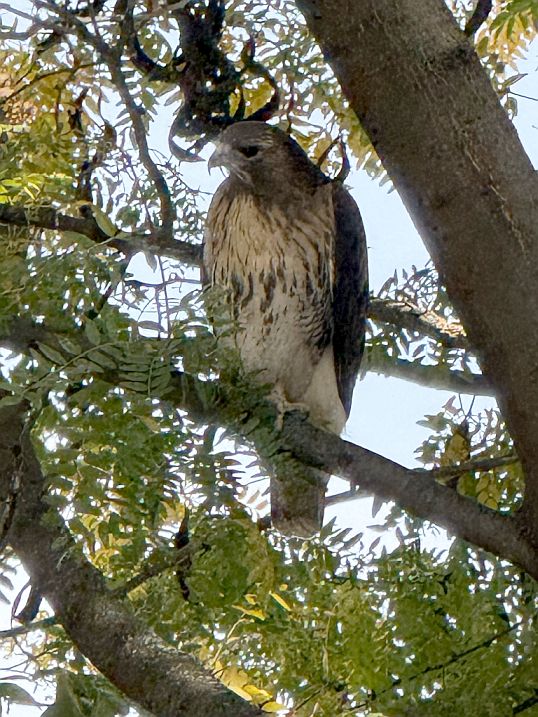 |
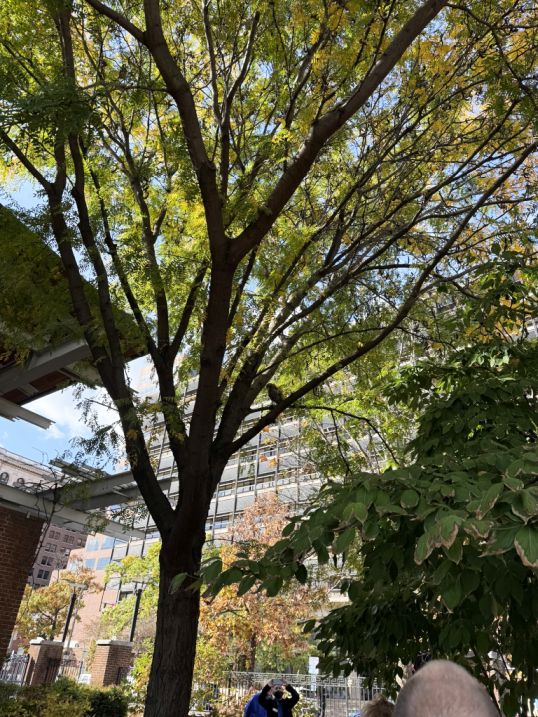
As we are standing around we saw a Red-tailed Hawk resting on a tree branch. Our tour guide told us that Red‑tailed Hawks are one of the most common urban raptors in the eastern United States, and Philadelphia is full of perfect places for them to live and hunt. So seeing one calmly perched on a branch is normal but still a special moment for us.
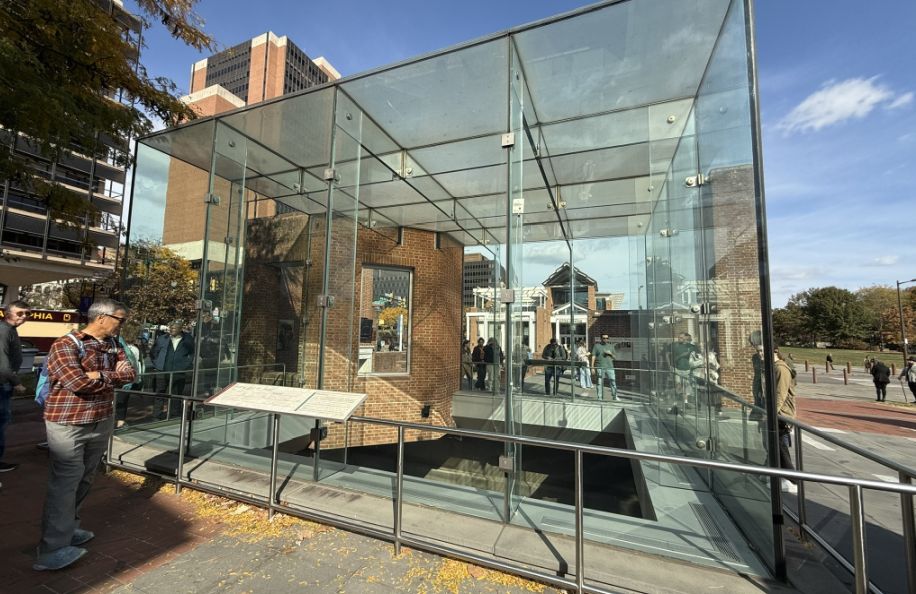
The glass structure is part of the archaeological site of the President's House Site. For many years, this history was largely overlooked, especially the story of the enslaved people who lived and worked there.
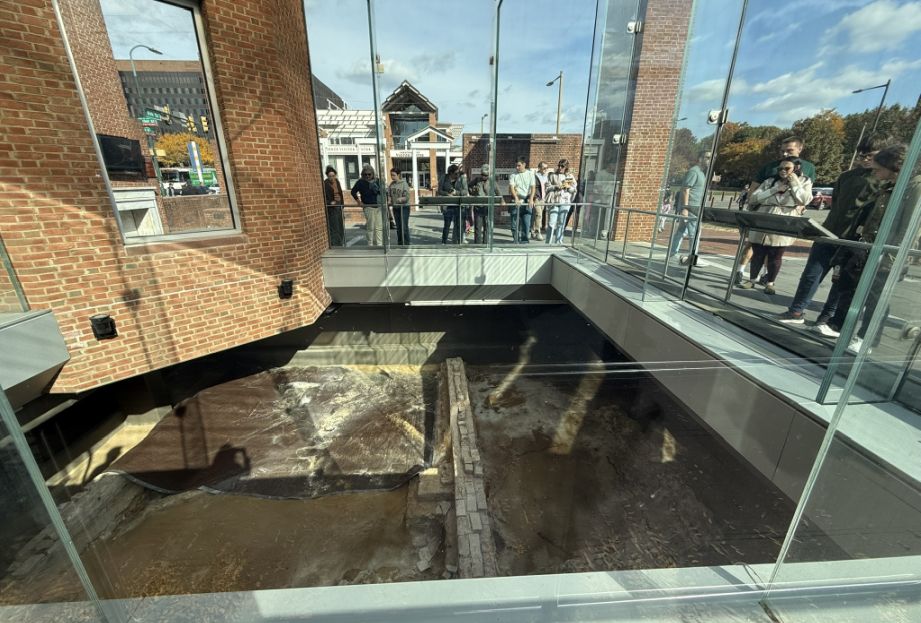
The glass allows visitors to look down into the foundations of what was once the executive mansion of Presidents George Washington and John Adams (1790–1800), when Philadelphia was the nation’s capital. The physical foundations of the house (uncovered during 21st-century excavations) and The stories of the enslaved Africans who lived there.
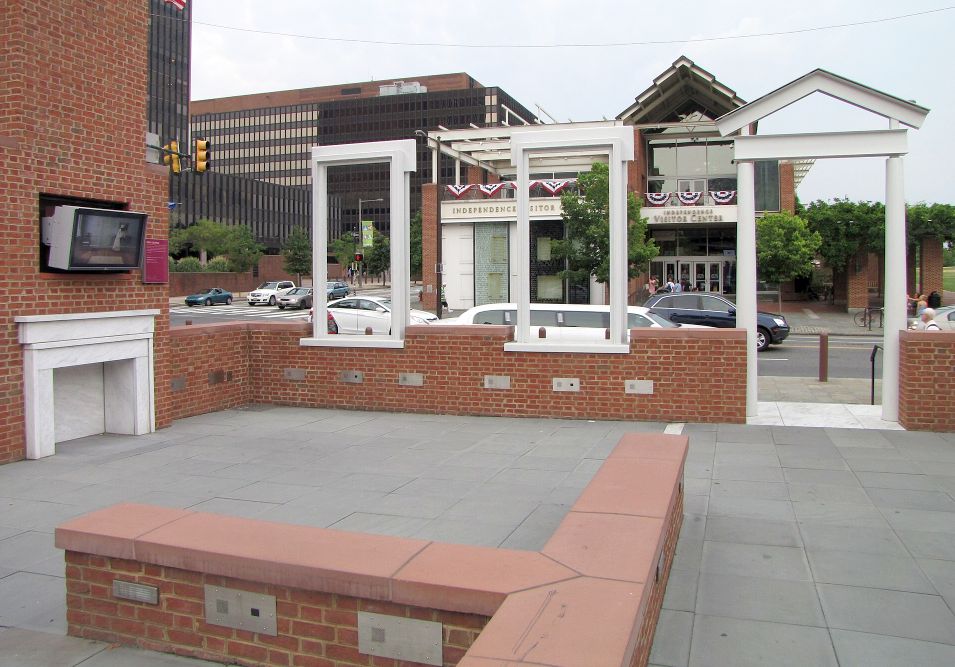
The President's house Memorial, looking North. The Philadelphia house was located on what is now Market Street, one block north of Independence Hall (then known as the Pennsylvania State House). It was the third U.S. presidential mansion. George Washington occupied the Philadelphia President's House from November 27, 1790 to March 10, 1797. John and Abigail Adams occupied the house from March 21, 1797 to May 30, 1800.
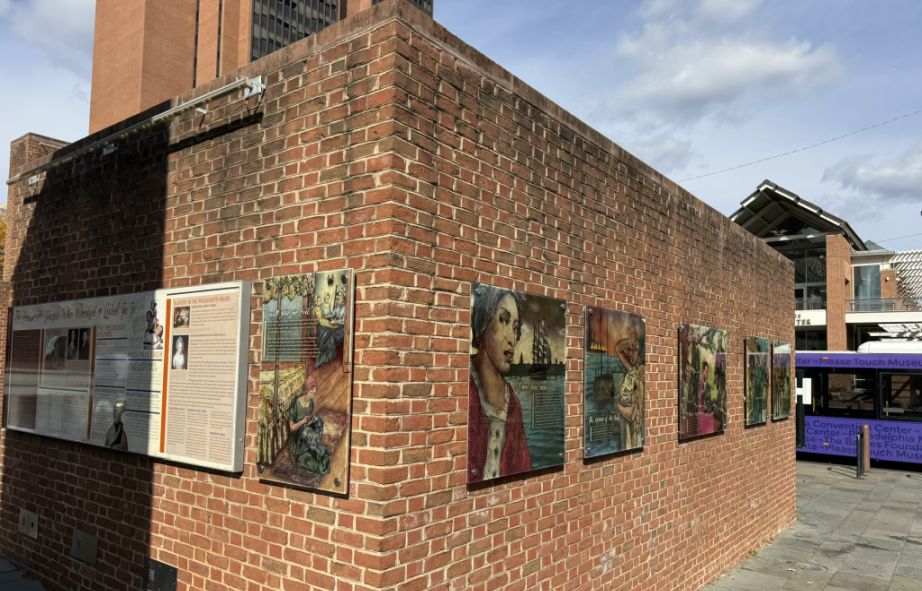
The Slavery Memorial with a brick wall with paintings and interpretive panels tells the story of the nine enslaved Africans held by George Washington while he lived in Philadelphia. Because Pennsylvania had a gradual abolition law, Washington rotated enslaved individuals in and out of the state to prevent them from qualifying for freedom under state law. That tension, liberty being debated inside Independence Hall while slavery continued nearby, slavery is one of the most powerful and uncomfortable truths explored on modern tours.
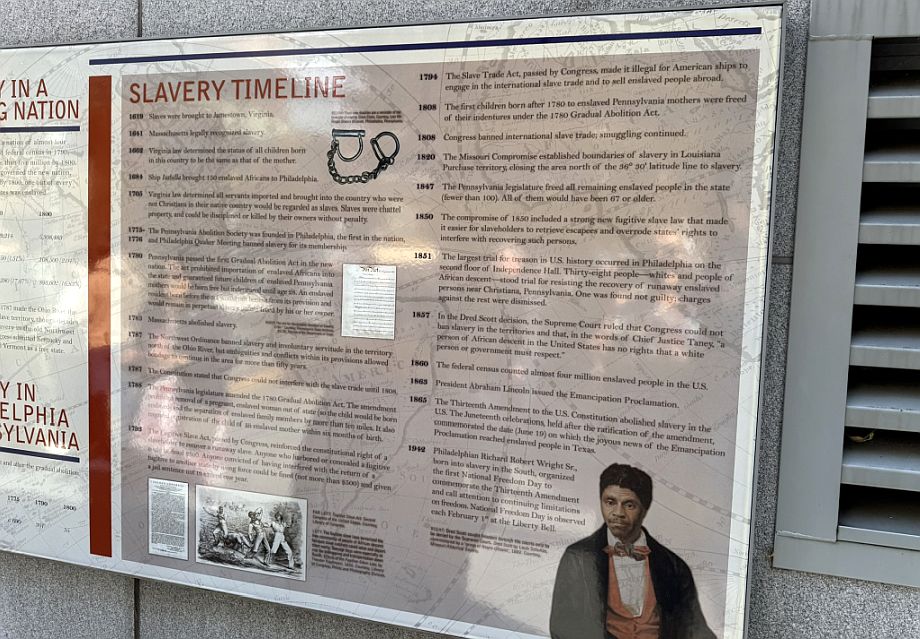
The slavery timeline usually traces the development of slavery from: the arrival of the first enslaved Africans in British North America (1619), the expansion of chattel slavery in the colonies, Pennsylvania’s 1780 Gradual Abolition Act, the contradiction between Revolutionary ideals and continued enslavement. One of the key tensions highlighted in Philadelphia is this: while delegates debated liberty inside Independence Hall, slavery remained legal and economically entrenched.
Pennsylvania’s gradual abolition law did not immediately free enslaved people, it applied mainly to future generations. That nuance is important. Freedom was incremental, limited, and uneven.
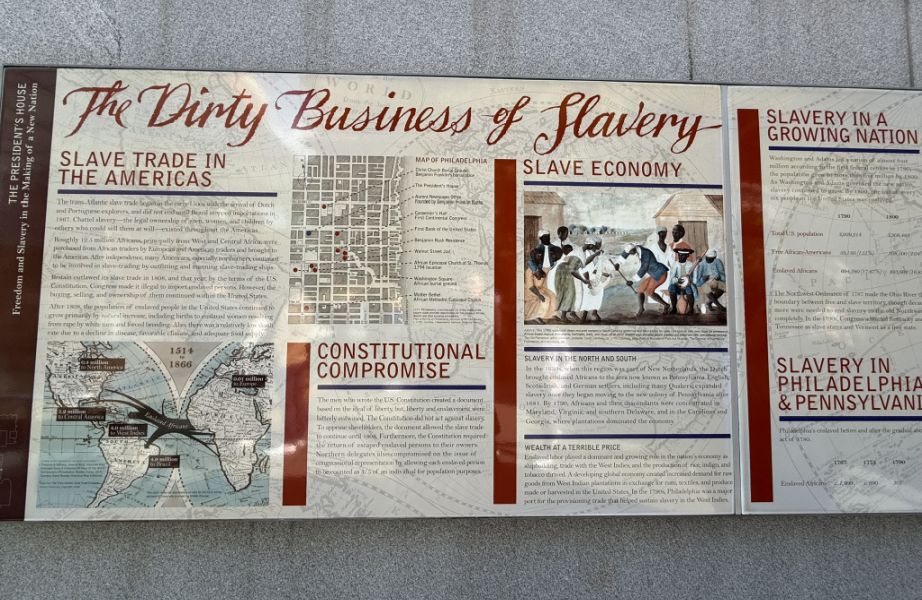
“The Dirty Business of Slavery”, this panel focuses on the economic engine behind slavery. Slavery was not just a Southern plantation system, it was a national and international business network involving: shipbuilding, Insurance companies, Banks, Merchants, Northern ports, and even cities like Philadelphia were tied to slave-produced goods such as tobacco, sugar, and cotton.
The panel likely explains how enslaved people were treated as property, bought, sold, insured, taxed. Families were separated. Human lives were calculated in financial terms.
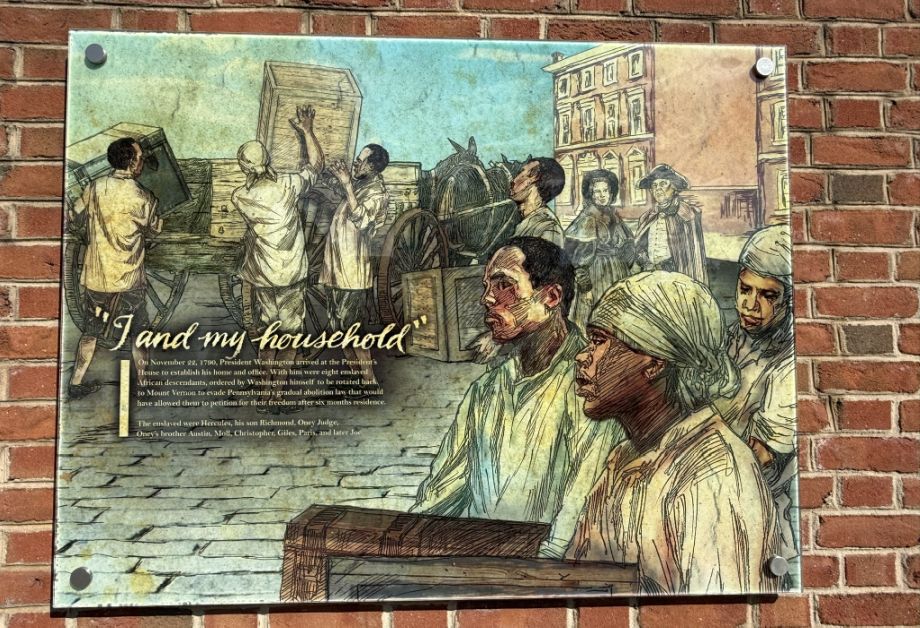
These paintings are part of the interpretive installation at the President's House Site within Independence National Historical Park. They’re contemporary works meant to humanize the enslaved people who lived here and to confront the contradictions of the founding era.
“I and My Household” The title echoes biblical language often used by early Americans (“As for me and my house…”). In this context, it raises a painful irony: while founders spoke about governing their “households” and the new republic, enslaved people were legally considered part of that household, as property, not as citizens. The painting typically emphasizes family bonds, either preserved despite enslavement or threatened by it. It reminds viewers that enslaved individuals had spouses, children, relationships, and inner lives, even though the law denied them autonomy.
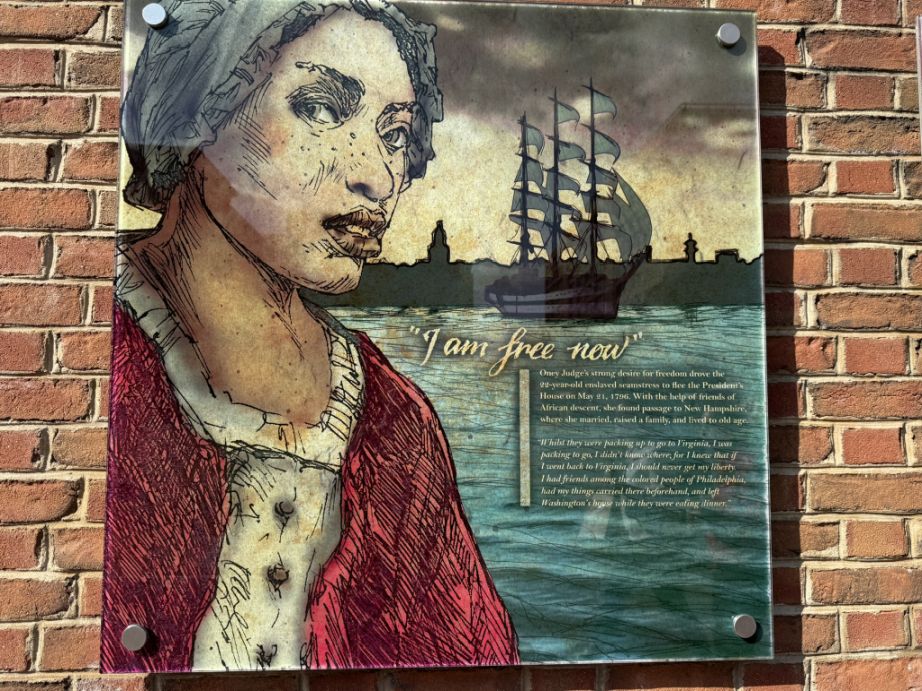
“I Am Free Now” This title speaks directly to escape and self-liberation and referrer to Oney Judge, a 22 year-old enslaved seamstress who escaped from the household of George Washington while she was living in Philadelphia. With the help of friends of African descent, she found passage to New Hampshire, where she married, raised a family and live to old age.
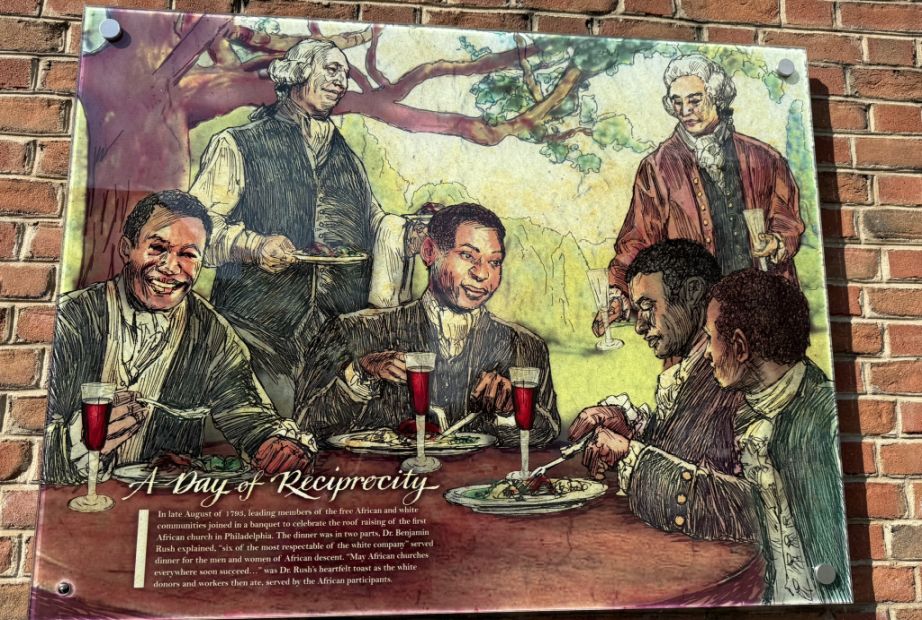
“A Day of Reciprocity” In late August of 1793, leading members of the free African and white communities joined in a banquet to celebrate the roof raising of the first African church of Philadelphia. The Dinner was in two parts. Dr. Benjamin Rush explained. "Six of the most respectable of the white company" served dinner for the men and women of African descent. "May African churches everywhere soon succeed..." was Dr. Rush's heartfelt toast as the while donors and workers then ate, served by the African participants.
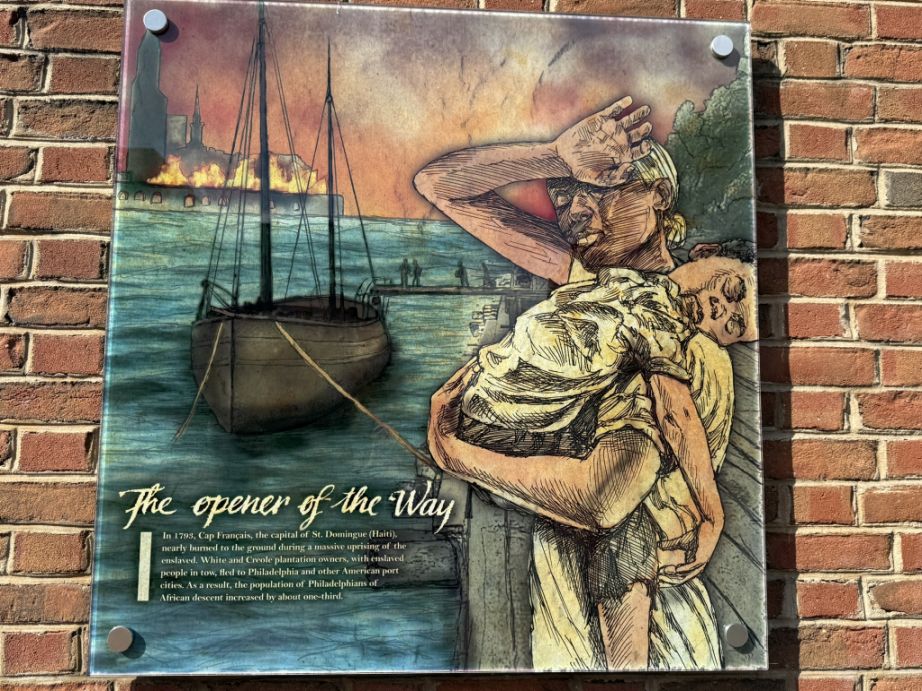
“The Opener of the Way” In 1793, Cap Francais, the capital of St. Domingue (Haiti), nearly burned to the ground during a massive uprising of the enslaves. White and Creole plantations owners, with enslaved people in town, fled to Philadelphia and other American port cities. As a result, the population of Philadelphians of African descent increased by about one-third.
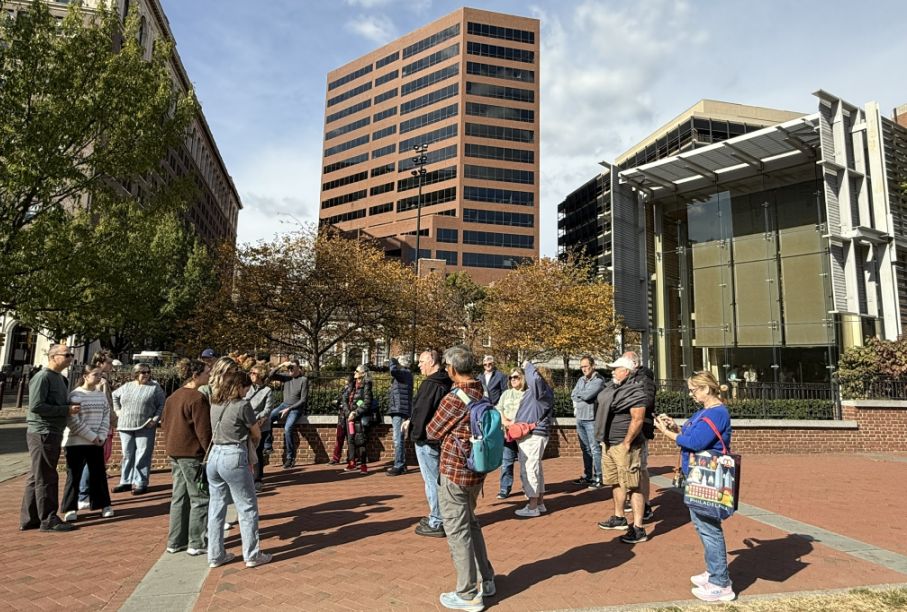
Gathering around our guide to hear all the stories about slaveries.
 |
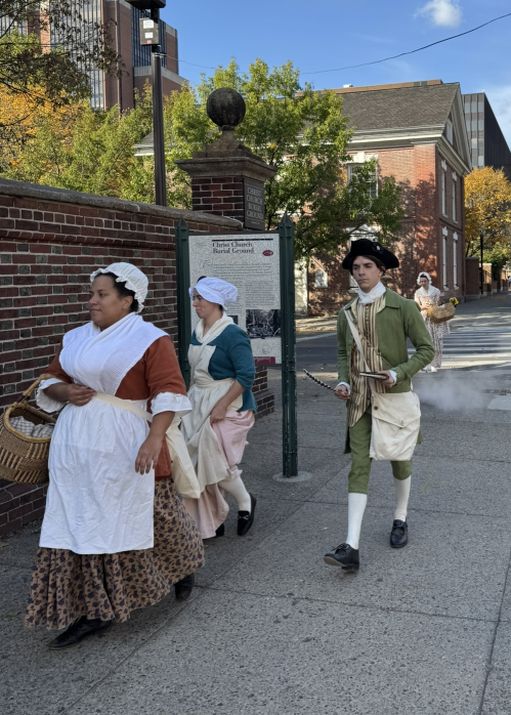 |
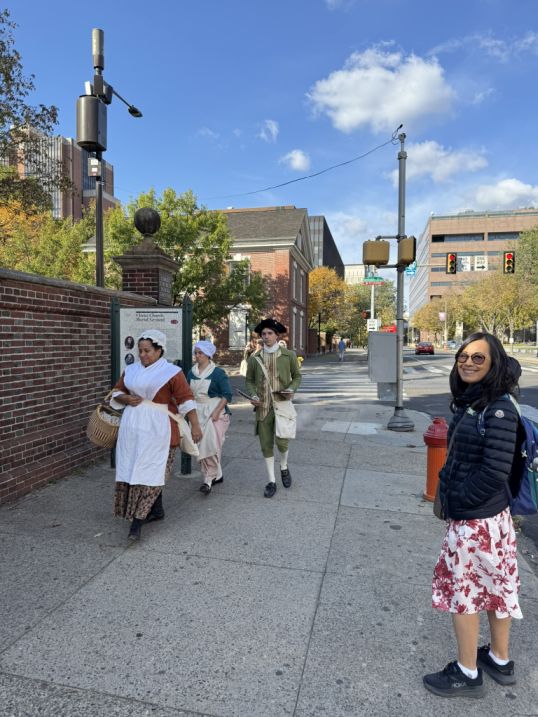
As we crossed the street toward Independence Hall we encountered people dressed in colonial clothing. It really brings the 18th century to life.
The three people dressed in period clothing are likely historical interpreters. The women in long dresses, white aprons, and bonnets resemble working-class colonial women. The man in green with a hat and batons could represent a militia member or town crier. They help visitors imagine daily life in 18th-century Philadelphia, not just the famous founders, but ordinary residents who lived, worked, and moved through these streets.
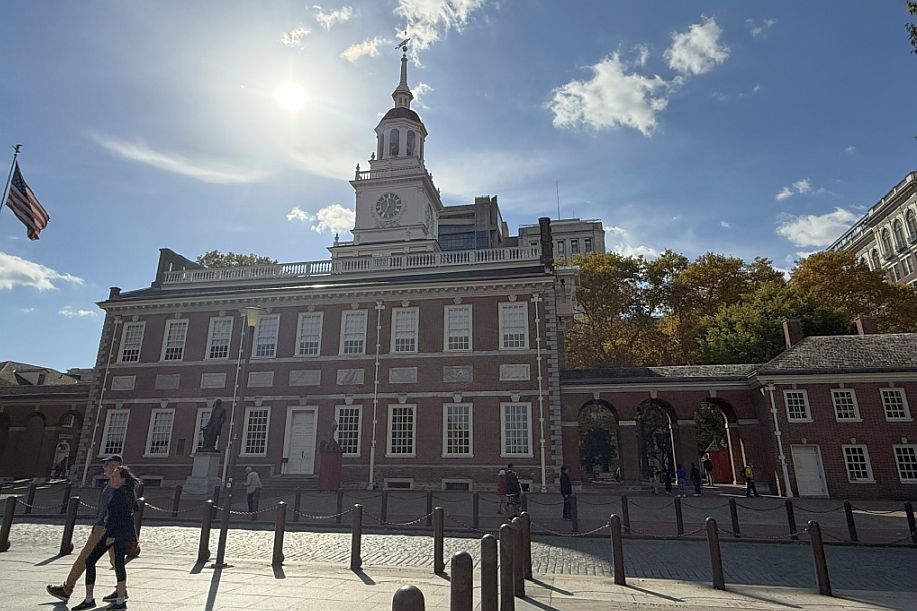
We stopped briefly at Independence hall, one of the most significant historic buildings in the United States. This is where representatives from the thirteen colonies gathered to decide whether to break from Britain, and later, how to structure a new form of government. Standing in front of it, you’re looking at the birthplace of American self-government.
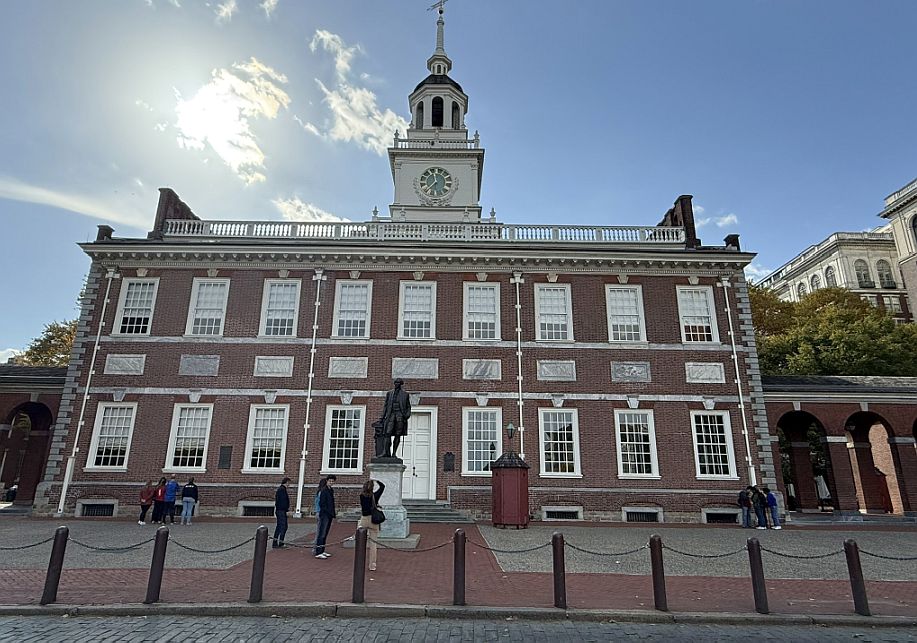
Originally built between 1732–1753 as the Pennsylvania State House, it became the political heart of the American Revolution. The red brick Georgian architecture is elegant but not overly grand. It reflects Enlightenment ideals, balance, proportion, reason. The clock tower rising above it became an enduring symbol of liberty.
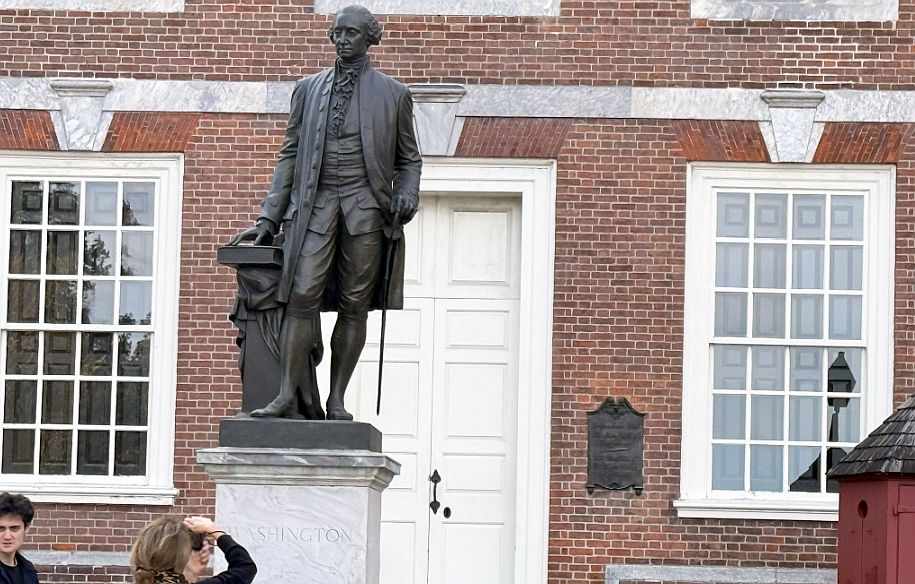
In front of Independence Hall is the statue of George Washington located on Chestnut street between 5th and 6th street. The white marble original of this statue, which was installed on the north side of Independence Hall, was dedicated on July 2, 1869, by mayor Daniel M. Fox. It is now located in Conversation Hall, Philadelphia City Hall.
The one on display now is a bronze replica replaced the original. Sculpted by Joseph Alexis Bailly (1825-1883), it stands approximately eight feet, six inches tall and was cast circa 1910 by the Roman Bronze Works, fabricated by P. Reinhalter & Company, and was then dedicated in October 1910. It sits on a base that is approximately six feet, eight inches tall that was made from marble and granite supplied by the Richmond Granite Company.
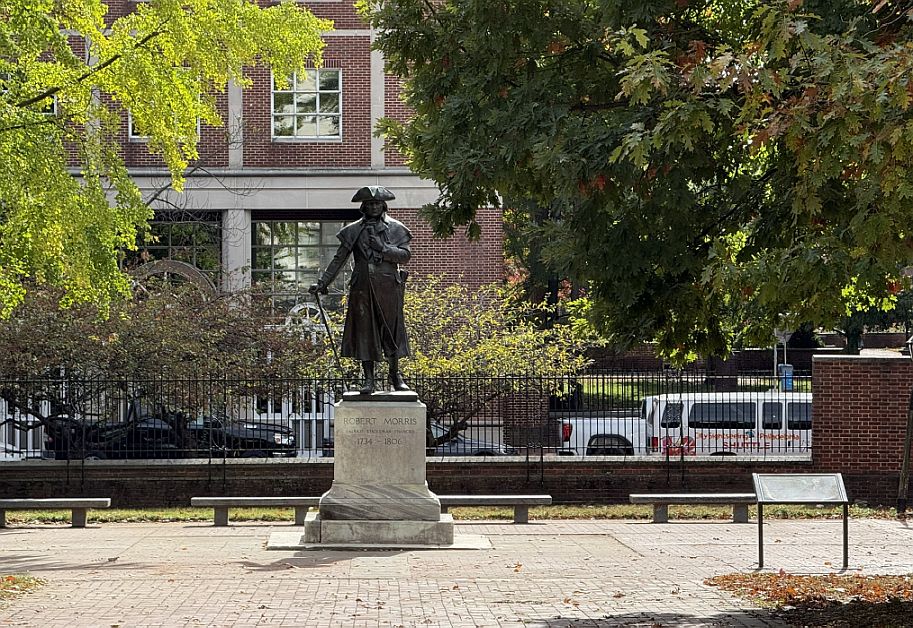
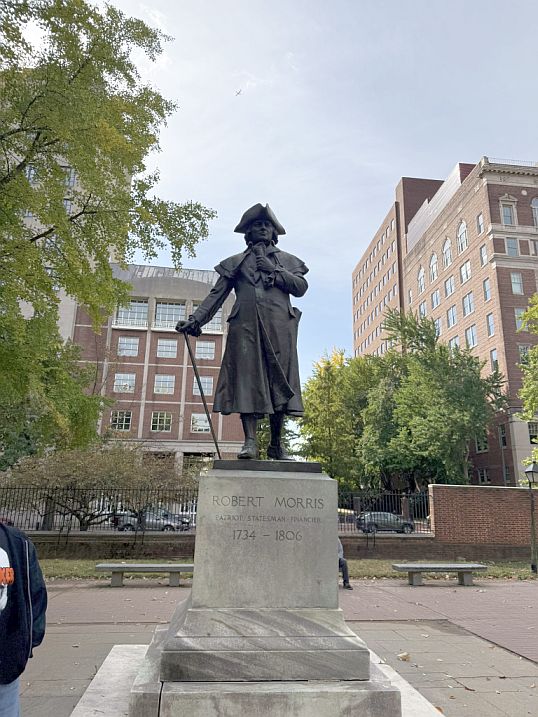
The statue of Robert Morris is located in Independence National Historical Park, the small green space at Independence Mall, just north of the Independence Hall complex.
Robert Morris was born in 1734 and became a wealthy Philadelphia merchant. He signed the Declaration of Independence, the Articles of Confederation, and the U.S. Constitution, one of only two men to sign all three. During the Revolutionary War, when the Continental Army was nearly bankrupt, Morris used his personal credit and business connections to secure loans and supplies.
 |
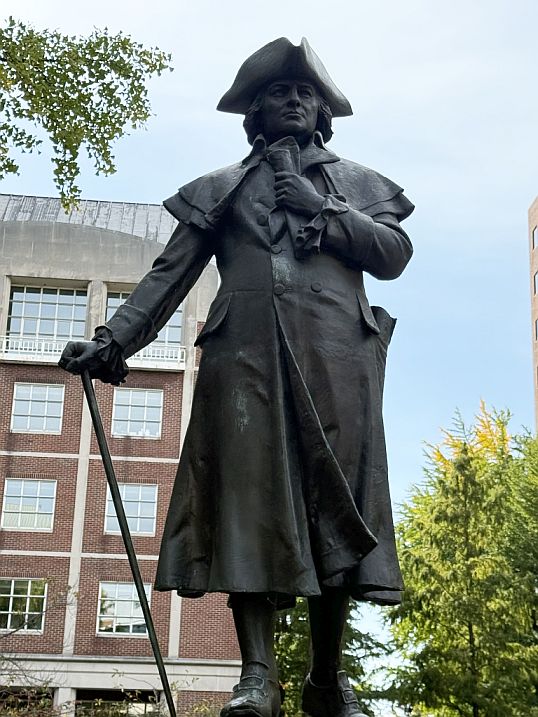 |
This part of Independence Mall represents the “civic center” of the Revolutionary era. Placing Morris here place him among the other founders. Reminds visitors that winning a revolution took not only battles, but financing, organization, and diplomacy, and honors a man who backed the Revolution with his own personal fortune. He is often called the “Financier of the Revolution” for this reason.
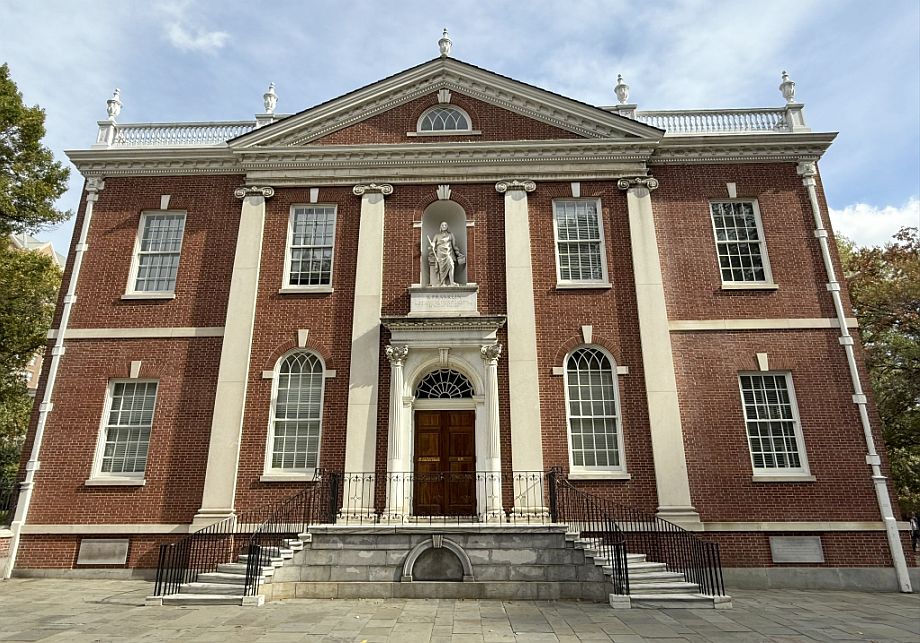
The Library Hall was originally the home of the Library Company of Philadelphia, the first successful lending library in America, founded in 1731 by Benjamin Franklin and his Junto club. The original building from the 1790s no longer exists, this Hall is a faithful 1950s reconstruction, built on the same site using historic plans and descriptions. Today, Library Hall serves as part of the American Philosophical Society (APS), also founded by Franklin which houses rare books, historical manuscripts, scientific collections, and early American documents.
The APS is one of the oldest learned societies in the United States, dedicated to science, knowledge, and public enlightenment.
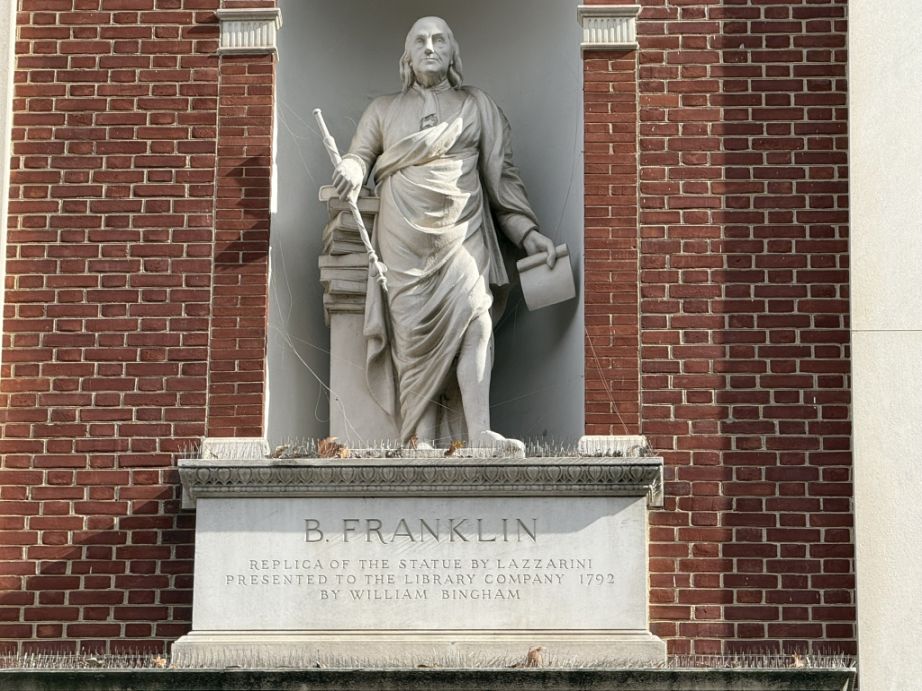
Statue of Benjamin Franklin is above the door and it is honoring the founder of the Library Company, and also marks Franklin’s role in creating America’s first cultural and scientific institutions.
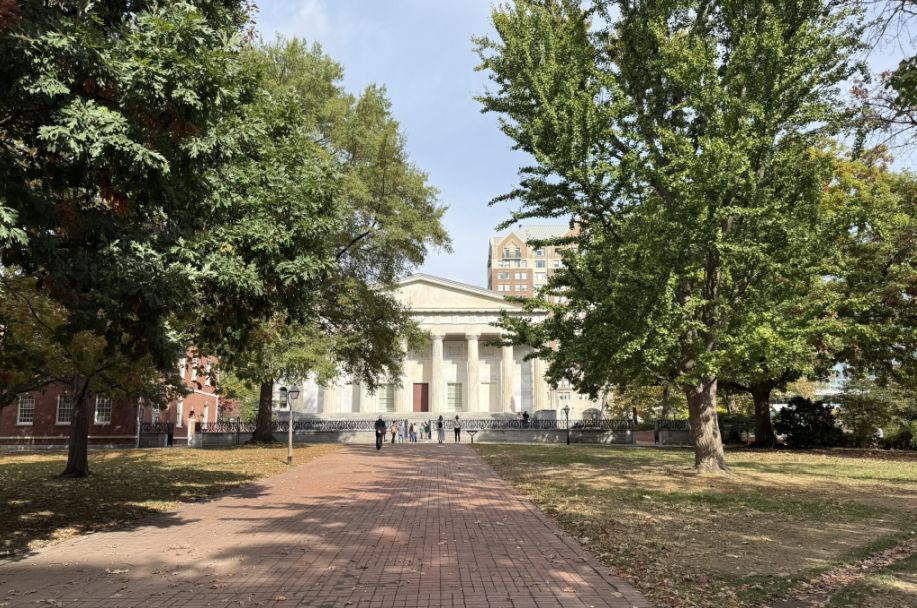
We are no walking toward the elegant and understated Second Bank of the United States. The walkway is lined with historic brick buildings and shaded by trees slows us down. The texture of the red bricks underfoot contrasts beautifully with the pale stone of the bank ahead. It feels intimate compared to the grand openness of Independence Mall, almost like stepping into a preserved 18th-century streetscape
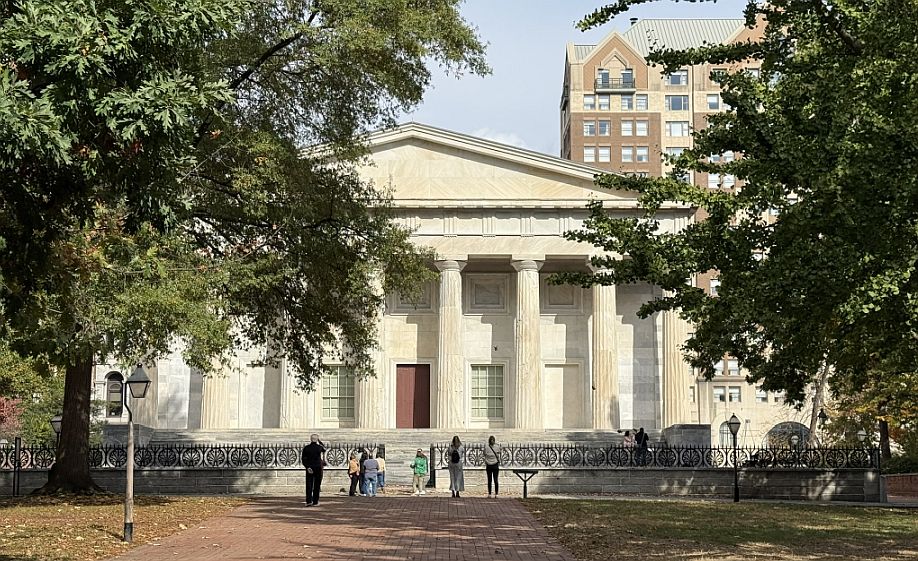
The entire building is modeled after ancient Greek temples, especially the Parthenon in Athens. This was a deliberate style choice: early Americans associated Greek architecture with democracy, civic virtue, and national strength. The Second Bank sits on a raised stone base. This creates the feeling of stepping up to a temple or monumental civic space.
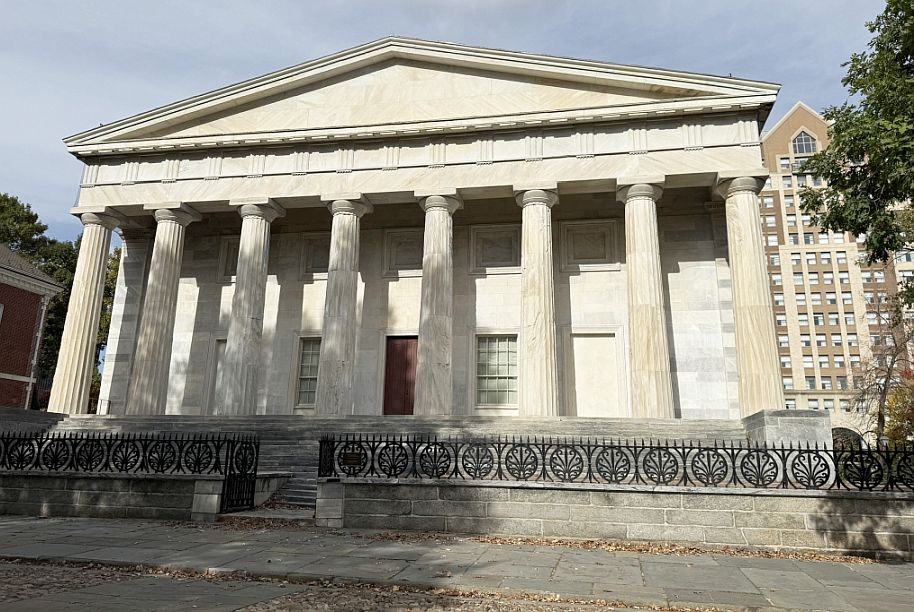
The marble gives the building its brilliant white appearance. It was meant to symbolize the strength and permanence of the United States after the turmoil of the early 1800s.
Created after the War of 1812 to stabilize the American economy.
Today the building belongs to Independence National Historical Park and houses the dozens of original 18th‑ and early 19th‑century portraits, many by Charles Willson Peale and members of the Peale family, and includes Founders, political leaders, scientists, diplomats, and Revolutionary figures.
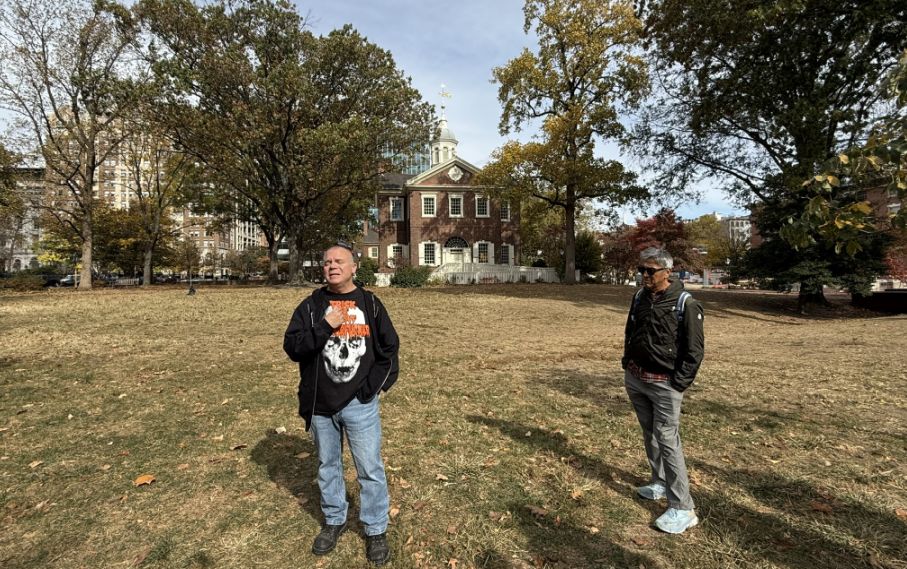
Our tour guide talking about the Carpenter's Hall (the brick house in the background).
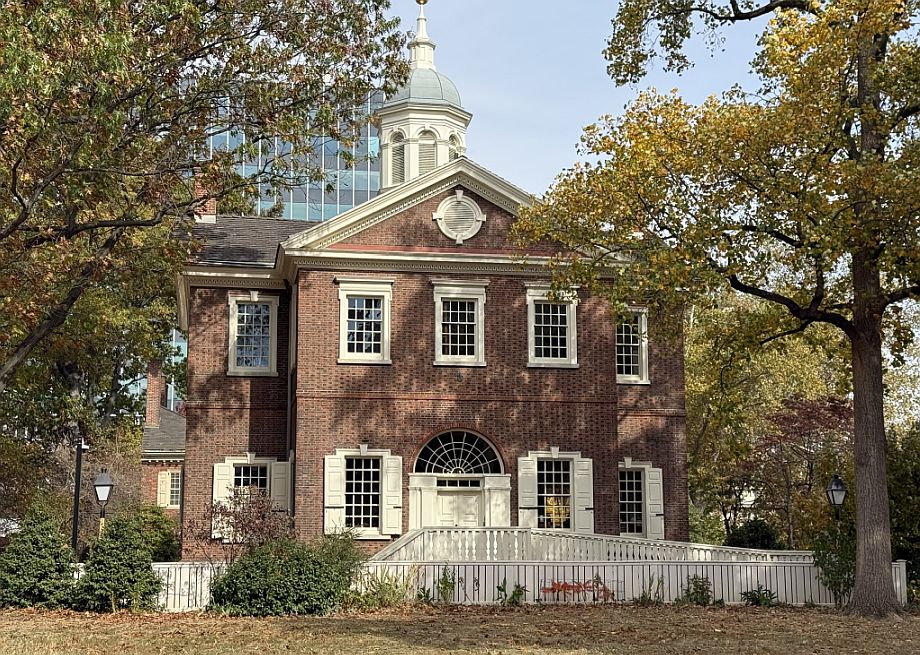
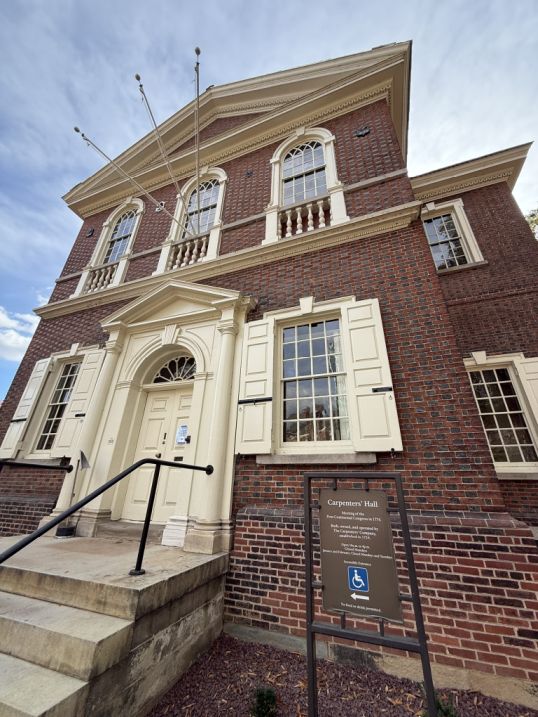
Carpenters’ Hall (1770-1774), one of the most important buildings in early American history, and a key stop on many Revolutionary-era tours in Philadelphia.
Carpenters’ Hall was the headquarters of the Carpenters' Company of the City and County of Philadelphia, a guild of master builders, architects, and craftsmen. This guild was one of the earliest professional organizations in America, and its members helped build many of Philadelphia’s major landmarks, including parts of Independence Hall.
 |
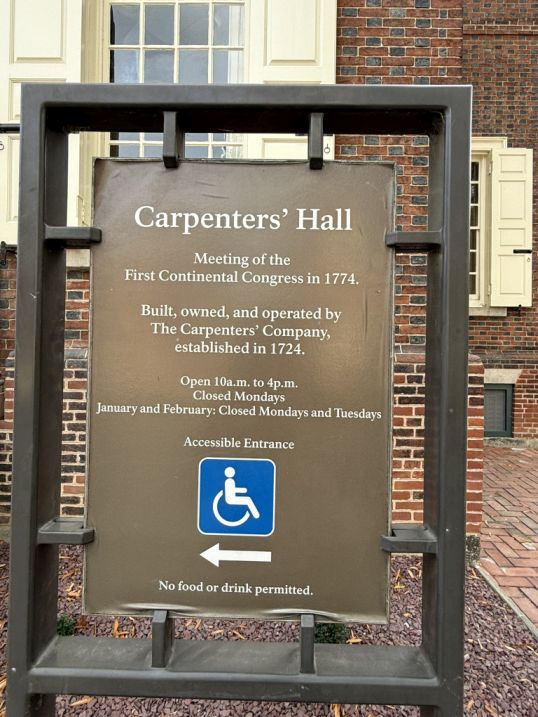 |
The most important event associated with Carpenters’ Hall is that it hosted the First Continental Congress in 1774. Delegates from 12 colonies (all except Georgia) met here to discuss British taxation and colonial rights, coordinate resistance to the Intolerable Acts, and begin the cooperation that would lead to the Revolution.
So this building is often considered the birthplace of unified American political action.
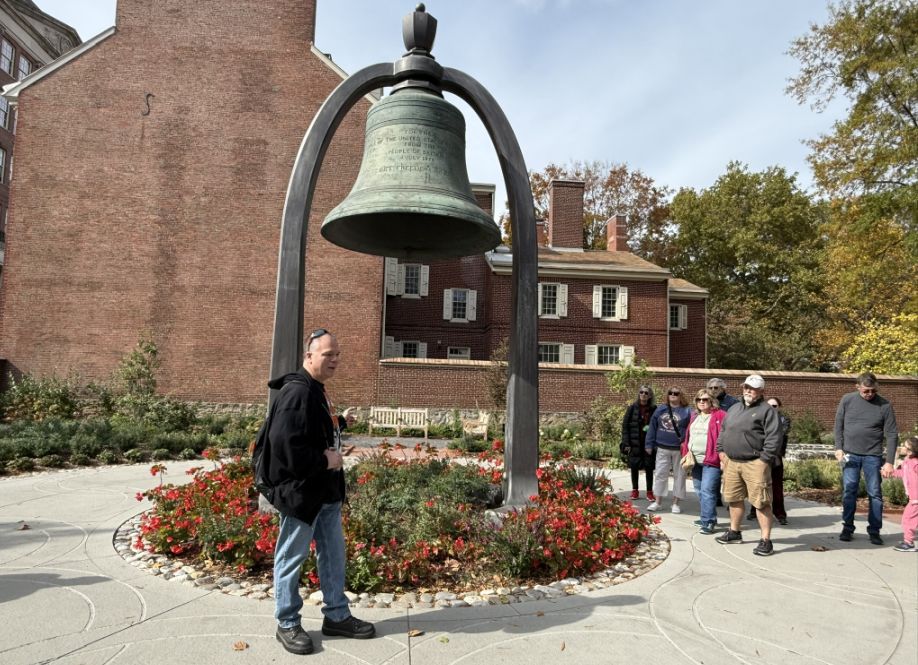
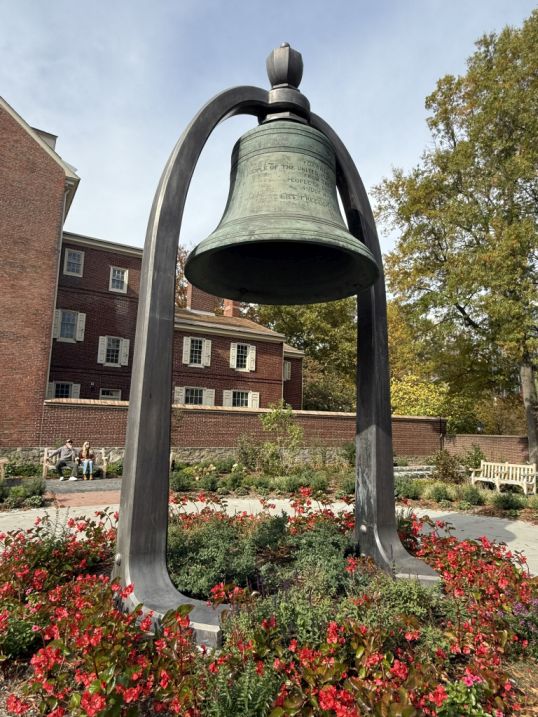
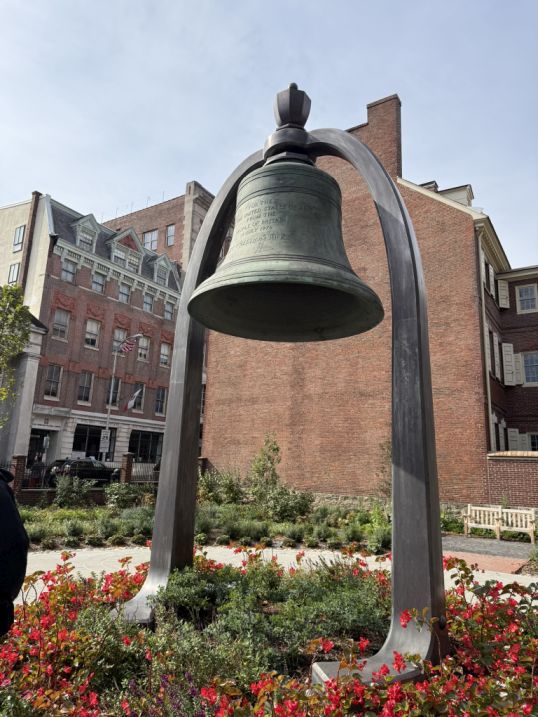
We are gathering around the Bicentennial Bell (1976) located in the Bicentennial Bell Garden, Walnut St & S. 3rd St.
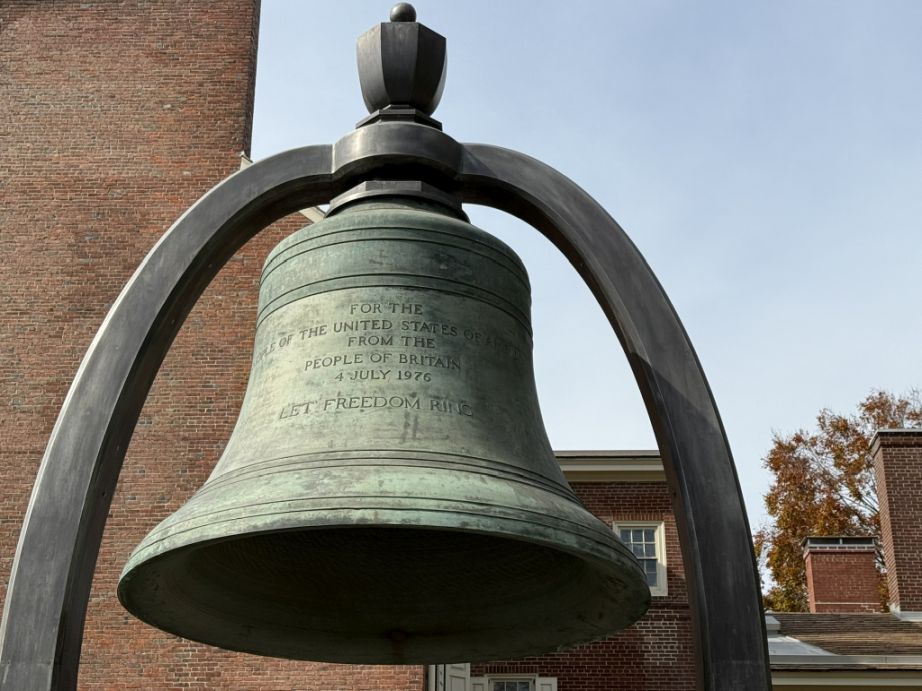
The bell was a present from Queen Elizabeth II. Presented to the United States in 1976 to celebrate America’s Bicentennial, the 200th anniversary of the Declaration of Independence.
The bell sits in a quiet little plaza beside the historic buildings of the park, very close to Carpenters’ Hall and the First Bank. It rang on July 6, 1976 during the ceremonial events marking 200 years of American independence.
 |
 |
The bell was given to honor centuries of shared history, and modern friendship between the U.S. and the U.K.
The bell was made at the Whitechapel Bell Foundry, London by the same foundry that made the original Liberty Bell in the 1700s. This creates a direct historical link between Philadelphia’s past and its modern celebration.
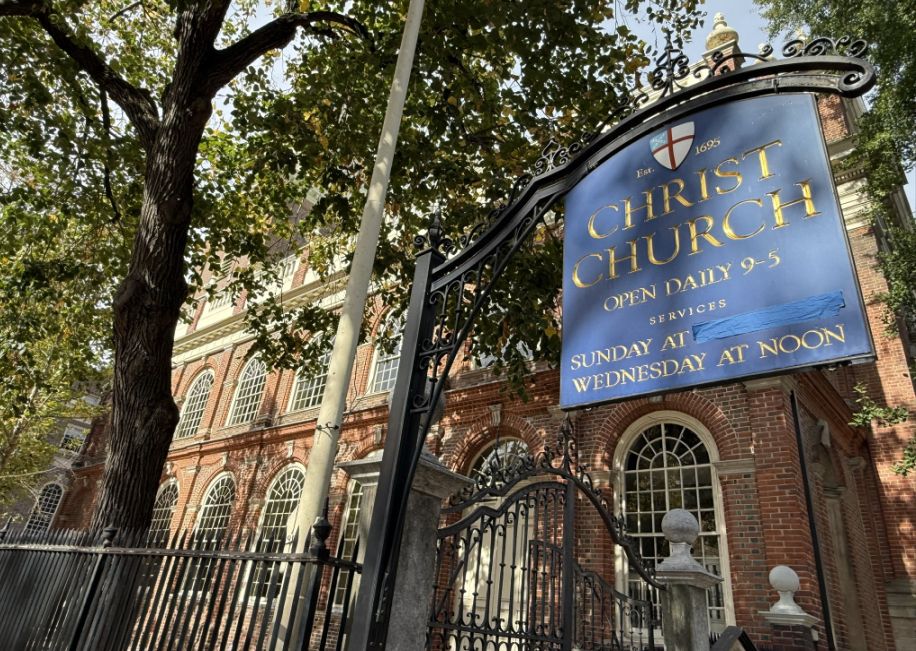
Christ Church is one of the most historic and influential churches in the United States. Founded in 1695, the current building (completed in 1744) quickly became the spiritual home of many of America’s founding leaders. Because of its deep ties to the leaders of the Revolution and the early government, it is often called “The Nation’s Church.”
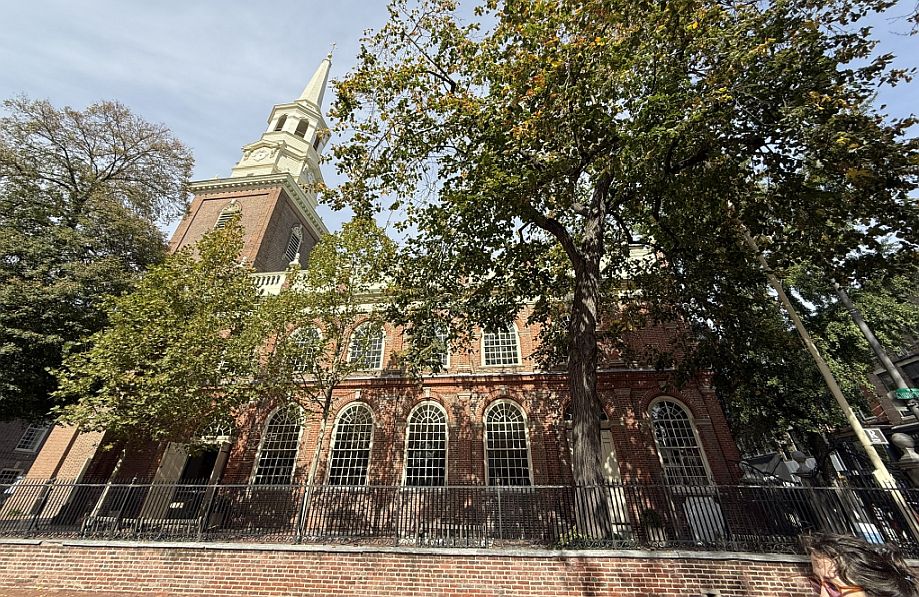
Many prominent figures worshiped here, including George Washington, Benjamin Franklin, Robert Morris, Betsy Ross, and John Adams. Members of the Continental Congress regularly attended services at Christ Church when they met in Philadelphia. After the Revolution, Anglican churches in America separated from the Church of England. Christ Church became central to this transition. Its rector, William White, became the first American Episcopal bishop and helped define the structure of the Episcopal Church in the new nation.
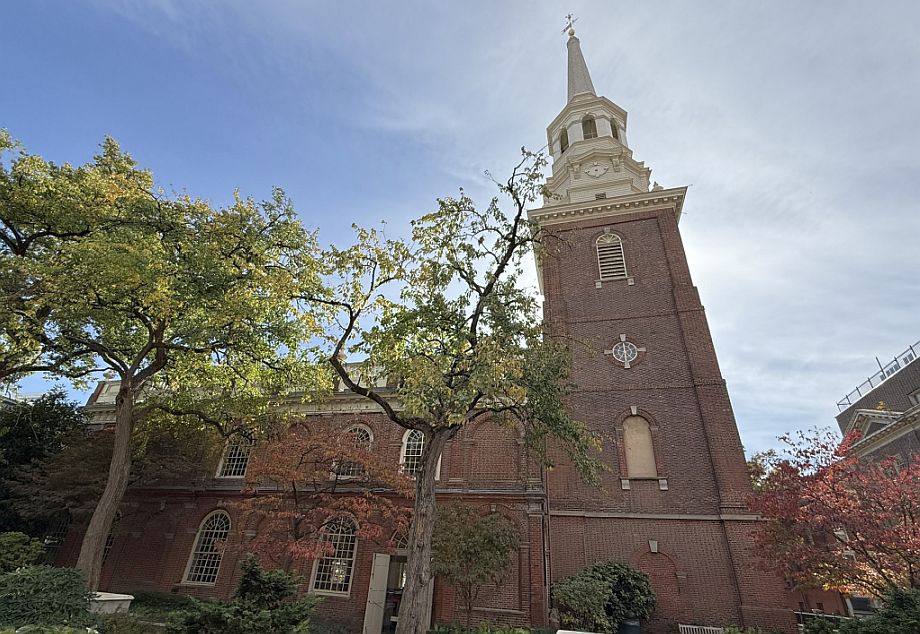
The steeple (added 1754) was the tallest building in the colonies until the early 1800s. For decades, it served as an important landmark for ships approaching Philadelphia on the Delaware River. Members of the Carpenters’ Company (the same guild who used Carpenters’ Hall) helped build the church. Much of the woodwork, pews, and interior detail were handcrafted by Philadelphia’s most skilled artisans.
 |
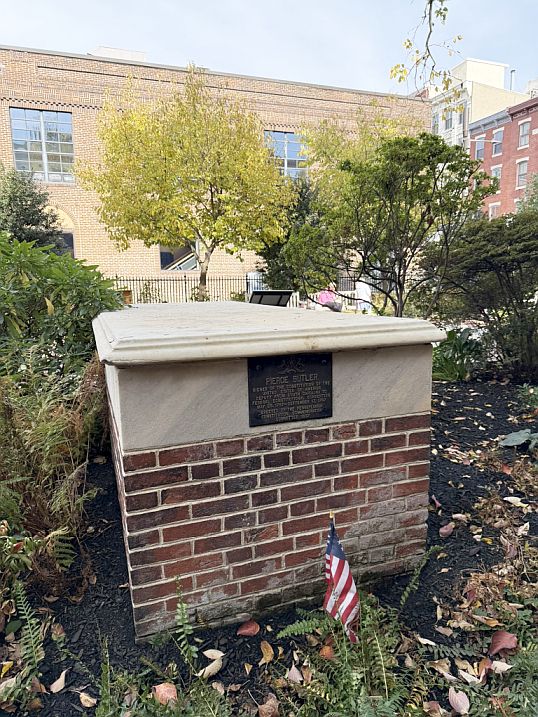 |
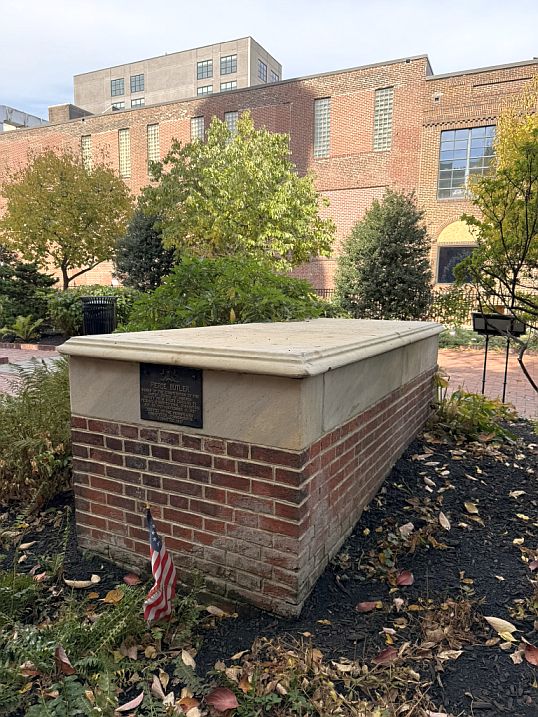
Christ Church’s graveyard was a prestigious resting place for early American
political leaders, especially those connected to the Constitution and early
Congresses.
It symbolized status, faith, and involvement in the founding of the nation.
Pierce Butler (1774-1822) was buried here.
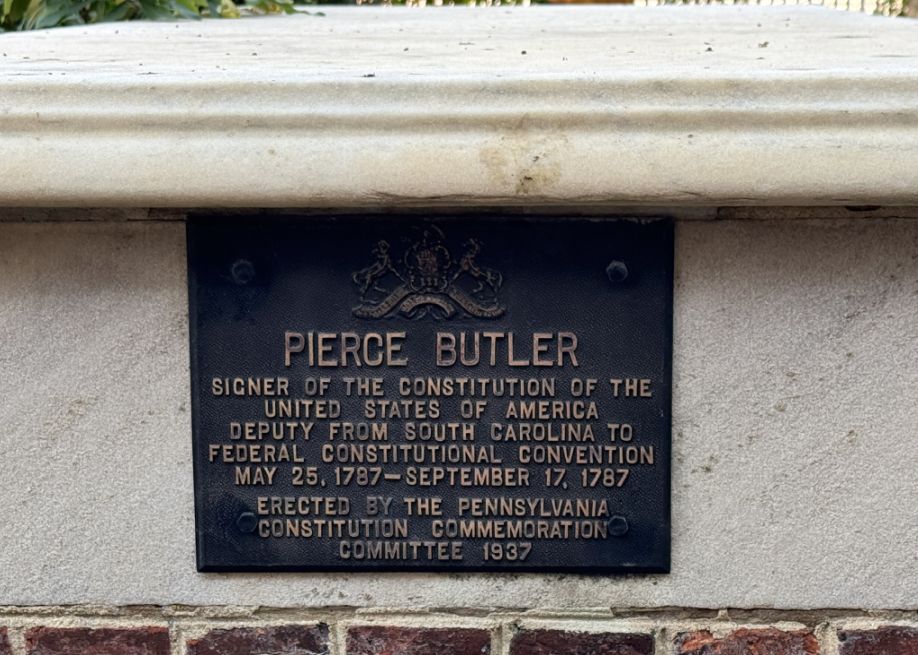
Pierce Butler was a Delegate to the Constitutional Convention, Signer of the U.S. Constitution, Senator from South Carolina, and one of the wealthiest plantation owners of his time.
He retired to Philadelphia later in life, which is why he is buried at Christ Church.
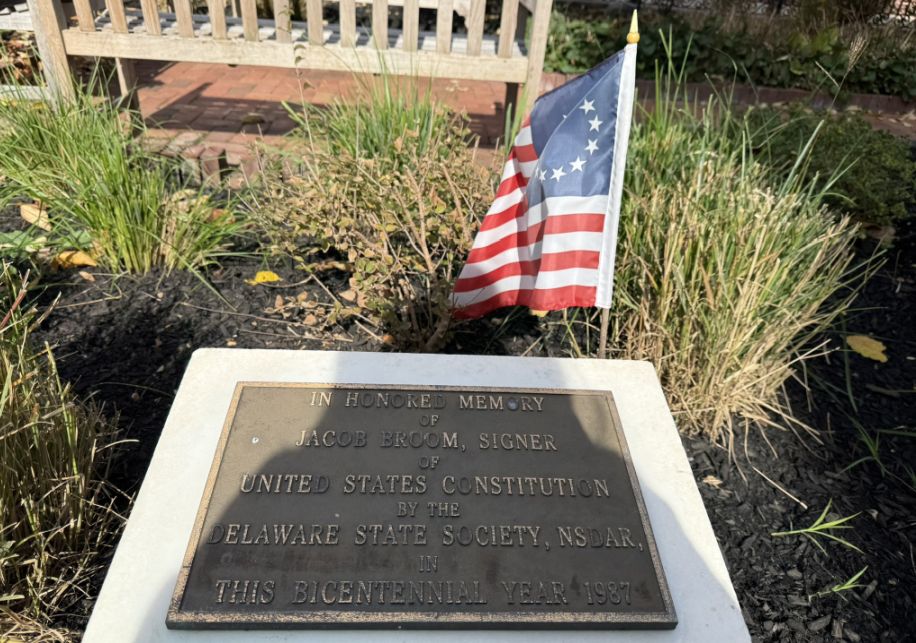
Jacob Broom (1752–1810) was a Delegate to the Constitutional Convention from Delaware, Signer of the U.S. Constitution, Surveyor, businessman, and civic leader, Not as widely remembered, but a committed supporter of a strong national government.
He spent time in Philadelphia for congressional business and also chose Christ Church as his burial place.
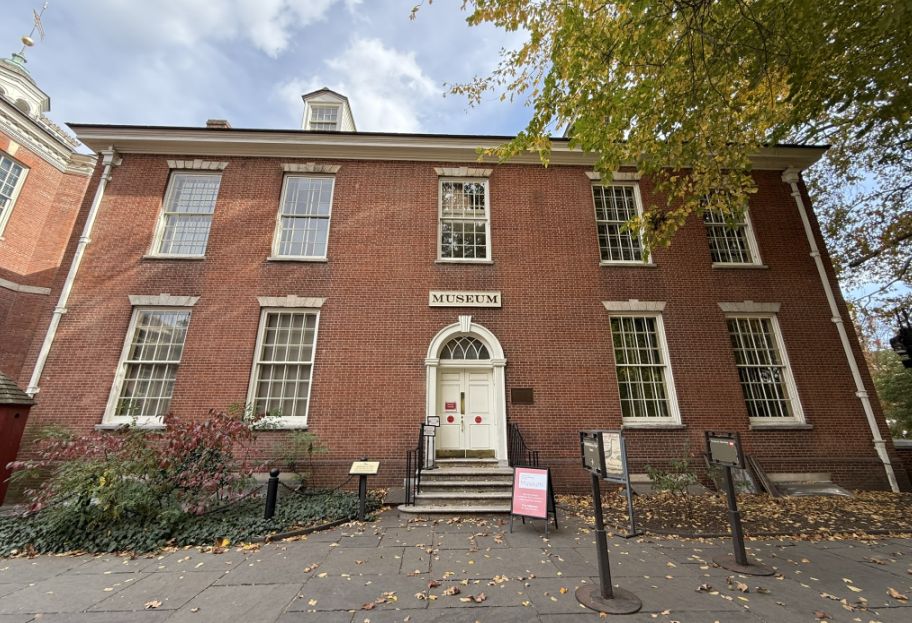
We are now done with the guided tour and we are now standing in the courtyard behind the Independence Hall and it is also called the rear Lawn of Independence Hall.
There is The American Philosophical Society Museum but it was closed so we only saw the exterior.
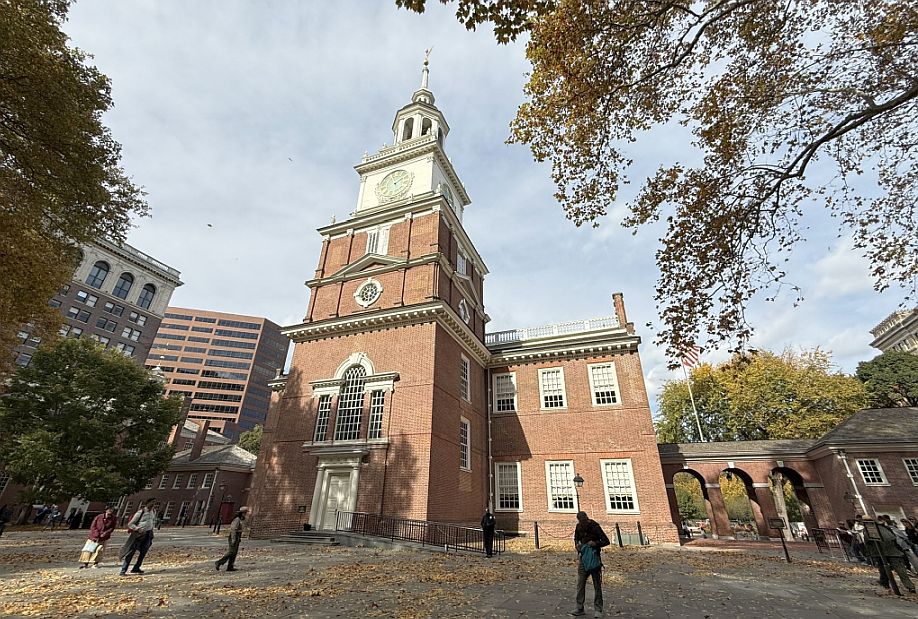
This rear courtyard was once part of the original grounds of the Pennsylvania State House (what we now call Independence Hall). In the 18th century it held Auxiliary government buildings, Meetings spaces, Law offices, and outdoor area used by members of the Assembly and the Continental Congress. Today, it’s a quiet place that provides a different, more intimate view of the building.
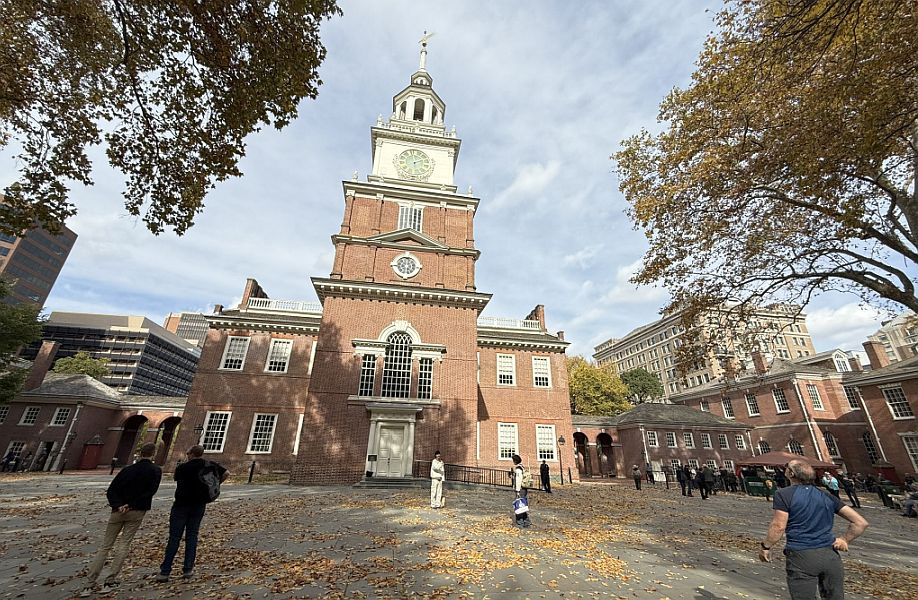
From the back, you can clearly see the steeple and clock tower, which rises above the central section of the building.
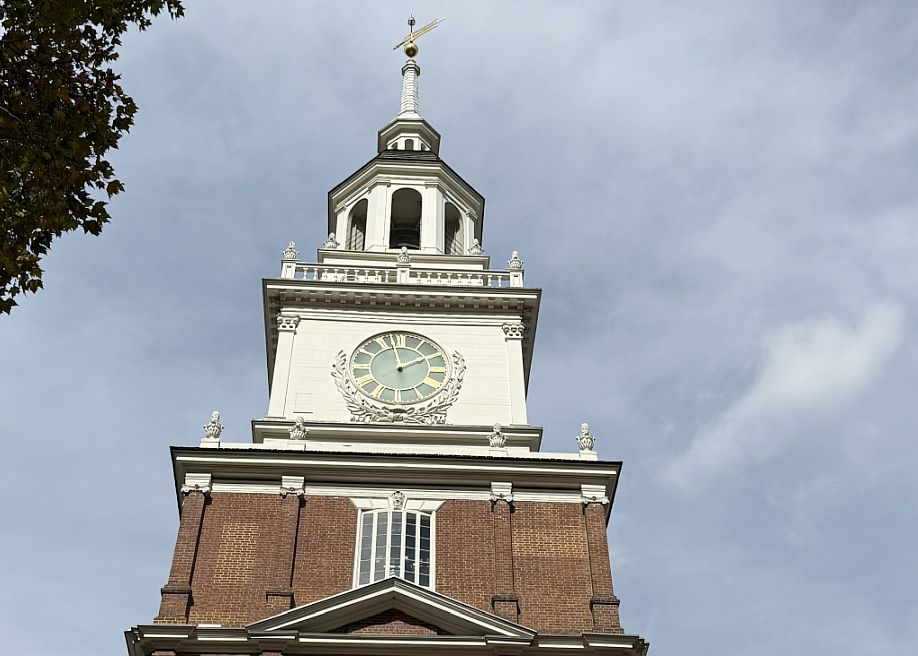
The tower originally held the Liberty Bell (before it was moved to the Liberty Bell Center).
The tower you see today is a reconstruction from the early 1820s, faithfully replicating the original lost to structural decay.
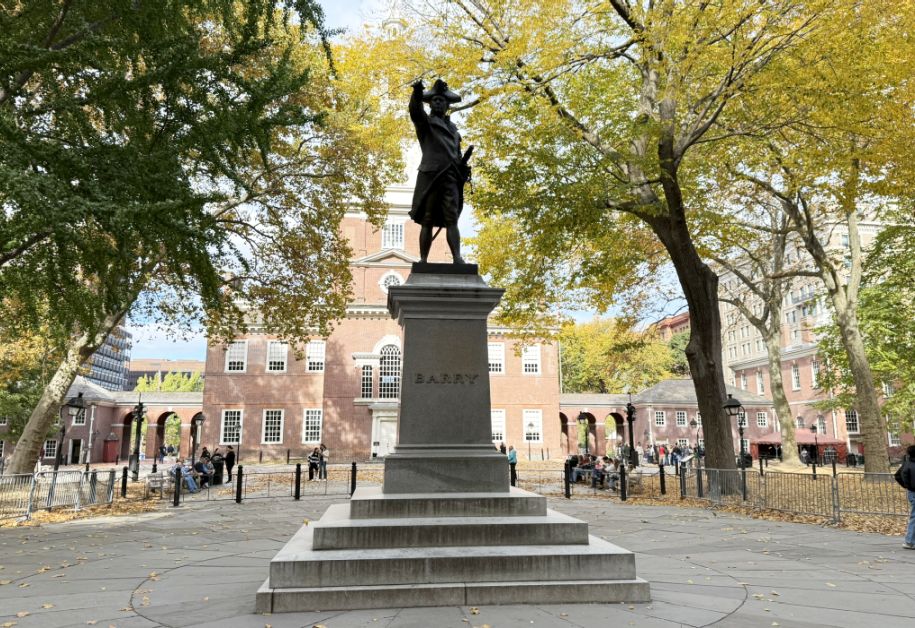
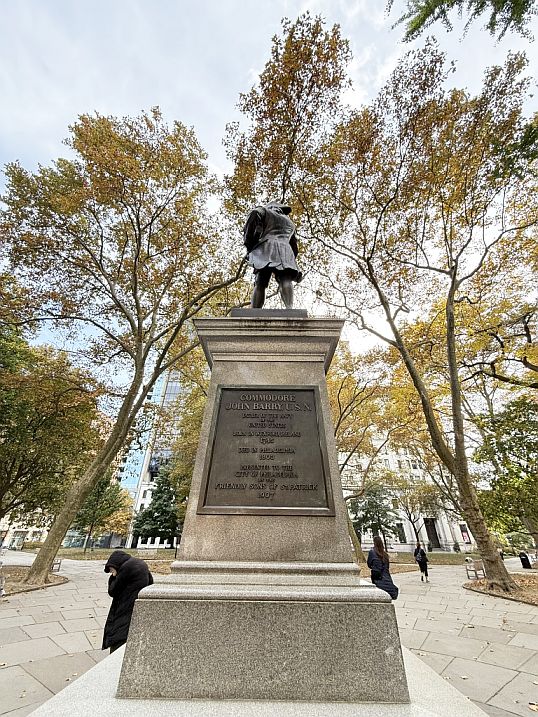
As we exited the courtyard, we passed a statue of Commodore John Barry, located just outside Independence Hall.
His contributions to the war effort and the early republic made him a major national hero. Philadelphia, being a major port and shipbuilding city, honors his naval legacy right beside Independence Hall.
 |
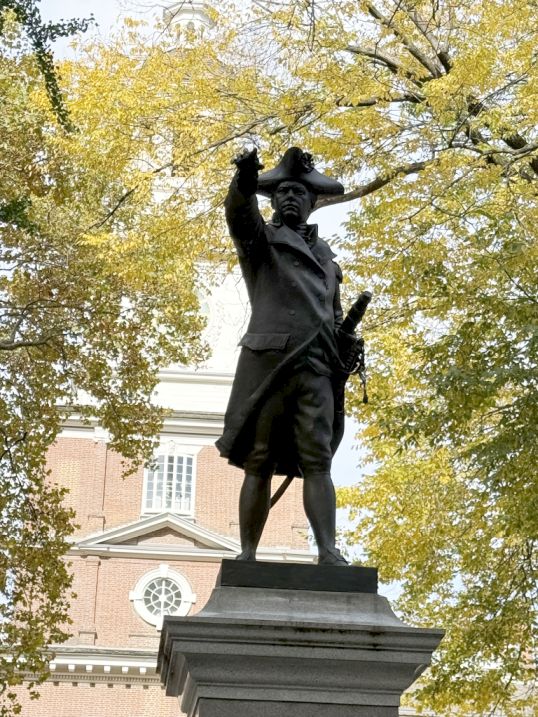 |
Commodore Barry was a naval officer during the American Revolution, often called the “Father of the American Navy” (along with John Paul Jones). He was a key commander in early naval battles, and an important figure in establishing the post‑Revolutionary U.S. Navy.
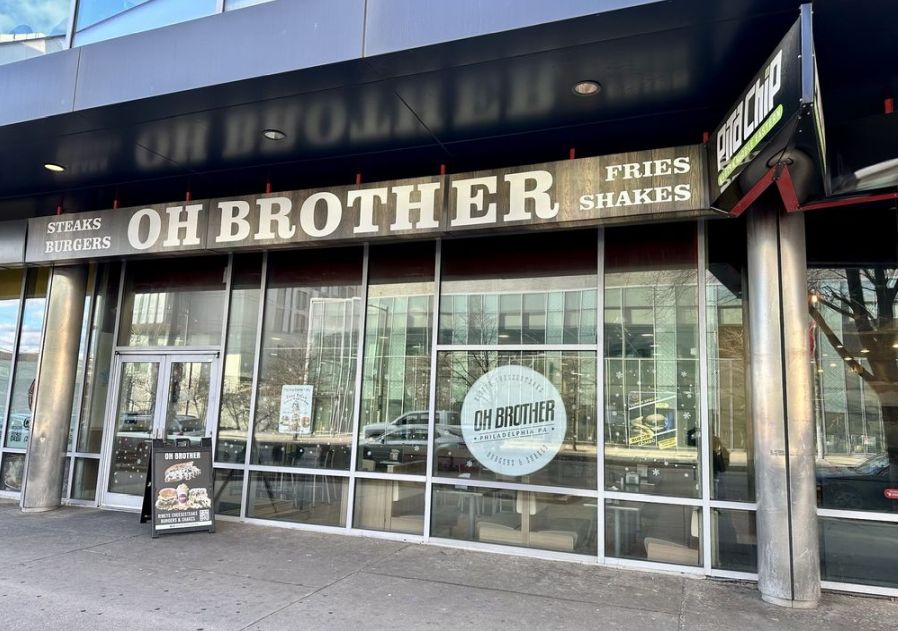
Our tour guide recommended Oh Brother on Market street. It is a casual burger and cheesesteak restaurant. It’s not one of the old-school, decades‑old cheesesteak shops, it’s more of a modern, creative, comfort‑food spot, but it has earned a strong fan base.
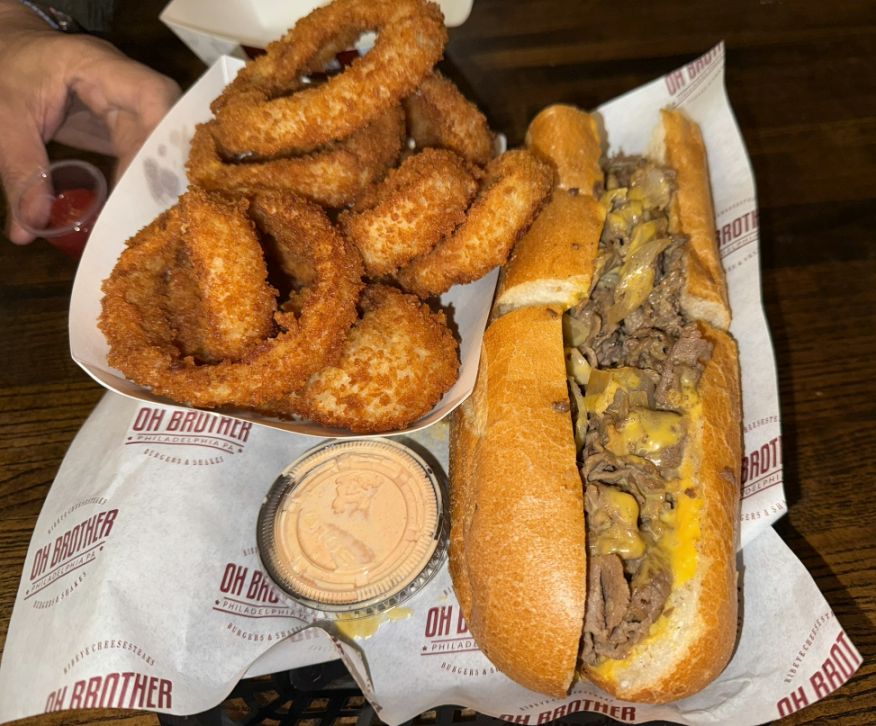
The portion is huge so we are so glad we shared a Philly cheesesteak, and onion rings.
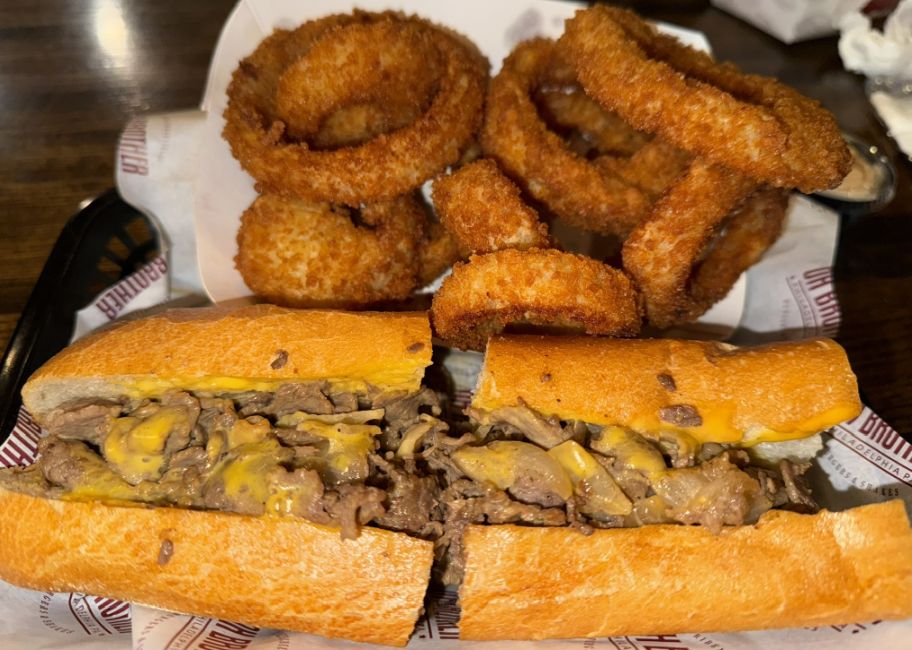
They’re known for using a lot of meat and a softer roll, making the sandwich feel rich and overstuffed. Their onion rings are some of the most-loved items on the menu.
Glad we stopped by this place for a very good Philly Cheesesteak!
NEXT... Day 3- Dinner at Amada