
5 days in Laos-1/31- 2/3/2025
|
Day 1 Vientiane |
Day 2-Vientiane Patuxai That Luong Buddha Park Tamnak restaurant |
Day 3-Vientiane Cope Museum Wat Si Muang |
Day 4-Luang Prabang Mekong River cruise Pak Ou Caves Lunch at Manifa Kuang Si waterfall Main Waterfall Manda de Laos |
Day 5-Luang Prabang Mount Phousi |
Day 3-Wat Si Muang, Vientiane -2/1/2025
After the sobering experience at the COPE Visitor Centre, our next stop was Wat Si Muang, one of Vientiane's most beloved and spiritually significant temples. For us, however, this visit was going to be much more personal than simply seeing another beautiful Lao temple. For Hoa, walking into Wat Si Muang brought back memories from his childhood. From the mid-1960s through the mid-1970s, he and his family used to come here to pray. At that time, members of Vientiane's Vietnamese community also attended the temple, and Hoa remembers it as a place believed to possess particularly strong spiritual power. Coming back all these years later made this visit feel very different from the other temples we had explored. We weren't simply arriving at a historic attraction; we were returning to a place that had been part of Hoa's childhood. The city around it had changed, and decades had passed, but people were still arriving with flowers and offerings, kneeling before the Buddha images and asking for blessings, much as families had done when Hoa came here as a young boy.
Wat Si Muang is unusual because it brings together Theravada Buddhism and much older beliefs in guardian spirits. The temple is associated with Vientiane's lak muang, or city pillar, which is believed to be the spiritual heart of the city and the home of its protective spirit. Even today, local people come here to pray for good fortune, health and help with important wishes. A common belief is that if a wish made here is granted, the person should return with an offering to give thanks.

The temple's best-known legend tells of a young woman named Nang Si Muang. According to tradition, she sacrificed herself when the city pillar was being established and became the guardian spirit associated with the site. Versions of the story differ, but the belief in Si Muang's protective presence has remained deeply rooted in Vientiane's spiritual life.
Perhaps that is what makes Wat Si Muang so interesting. It is not a temple preserved mainly for visitors to admire. It remains one of Vientiane's most active places of worship, where Buddhism, local spiritual beliefs and everyday life continue to come together.

From the moment we arrived, we could tell this was not simply a temple for tourists. The grounds were filled with people coming and going, many carrying elaborate offerings. We weren't sure whether there was a special observance that day; February 1 itself does not appear to have been one of Laos's major Buddhist festival dates in 2025. Wat Si Muang, however, is one of Vientiane's most active places of worship and attracts local devotees every day who come seeking blessings and good fortune.

Inside, the temple was very much alive. People knelt quietly in prayer while others sat on the floor in front of monks receiving blessings. There was incense, flowers and the soft murmur of prayers all around us. After visiting so many temples where we had mostly admired the architecture and Buddha images, here we felt as though we were witnessing Lao Buddhism as part of everyday life.

A man praying in front of an elaborate altar crowded with Buddha images. There seemed to be Buddha's everywhere, large and small, seated and standing, arranged on different levels so that the entire altar appeared to rise upward in layers. Unlike some temples where a single large Buddha dominates the room, here the many images gathered together gave the sanctuary an intimate, almost overflowing sense of devotion. The rear room is indeed known for an altar that occupies much of the space and is filled with Buddha images.
 |
 |
A man praying and giving offering in front of the altar.

What caught our attention immediately were the beautiful offerings people carried into the temple. Many looked like small towers, carefully constructed from folded green banana leaves and masses of bright yellow and orange flowers, particularly marigolds. We saw them everywhere, some quite large and elaborate. These arrangements, commonly called mak beng, are an important part of Lao religious ceremonies, and vendors traditionally make and sell them around Wat Si Muang. The brilliant orange and yellow marigolds are especially associated with Lao Buddhist offerings.

Kevin and Kristie decided to participate as well. They sat together on the floor in front of one of the monks, who chanted a blessing over them. He then tied a simple cotton thread around each of their wrists, blessing it as he did so.

The little bracelet may have looked simple, but the tradition behind it is deeply meaningful in Laos. White cotton threads are commonly associated with blessings for peace, good fortune, health and protection. The practice is closely related to the Lao Baci or Sou Khuan tradition, in which blessed threads are tied around the wrist as a way of securing well-being and good fortune. Traditionally, the thread is kept on for at least several days, and many people simply allow it to remain until it eventually falls away on its own.

The interior of the temple is decorated with an extraordinary amount of gold decoration. Gilded Buddha statues reflected the light, while carved golden columns, ornate details and brightly decorated ceiling panels made the interior seem to glow. Red, green and gold appeared throughout the room, creating the rich colors that we had come to associate with Lao temples.
 |
 |
After spending some time inside the temple, we slipped through a small doorway that led us outside onto the grounds of Wat Si Muang.

Almost immediately, we noticed that the spiritual experience didn't end at the door. Statues were scattered throughout the courtyard and gardens, Buddhas in different poses alongside guardian figures and other religious images. The grounds are known for their numerous Buddha statues and sacred figures, making the area surrounding the main temple feel almost like an outdoor extension of the sanctuary.

As we wandered around, we discovered something even more interesting: Wat Si Muang stands on a site that was sacred long before the present temple was built in 1563. Behind the main sanctuary are remnants of an older structure believed to be of Khmer origin, including an old laterite stupa and stone remains. Some of these ancient pieces have been incorporated into shrines and surrounded by Buddha images, blending the temple's distant past with the Buddhist traditions practiced here today.

It made our walk around the grounds particularly interesting. Some statues looked newly painted and brightly decorated, while others seemed weathered by years of sun and rain. There were Buddhas sitting peacefully beneath trees and religious figures tucked into corners that we might easily have missed if we had simply walked back out through the main entrance.

After the activity inside, the worshippers carrying flowers, people kneeling in prayer, monks chanting blessings and Hoa, Kevin and Kristie receiving their blessed wrist threads, the courtyard felt much quieter. We took our time wandering among the statues, enjoying this last peaceful part of a temple that had meant so much to Hoa and his family many decades ago.
 |
 |
After our visit to Wat Si Muang, it was time to say goodbye to Vientiane. We headed to the airport and boarded our flight north to Luang Prabang, the next chapter of our journey through Laos.

We boarded our flight and headed north, excited to discover a quieter and more traditional side of Laos in Luang Prabang.

The flight from Vientiane to Luang Prabang is about 45 minutes.

Luang Prabang
Even before arriving, Luang Prabang felt as though it would be very different from Vientiane. While Vientiane is the country's modern capital, Luang Prabang is the former royal and religious capital, nestled among the mountains of northern Laos on a peninsula formed by the Mekong and Nam Khan rivers. The historic town was designated a UNESCO World Heritage Site in 1995, recognized for the remarkable way traditional Lao architecture, Buddhist temples and later European colonial buildings exist together.
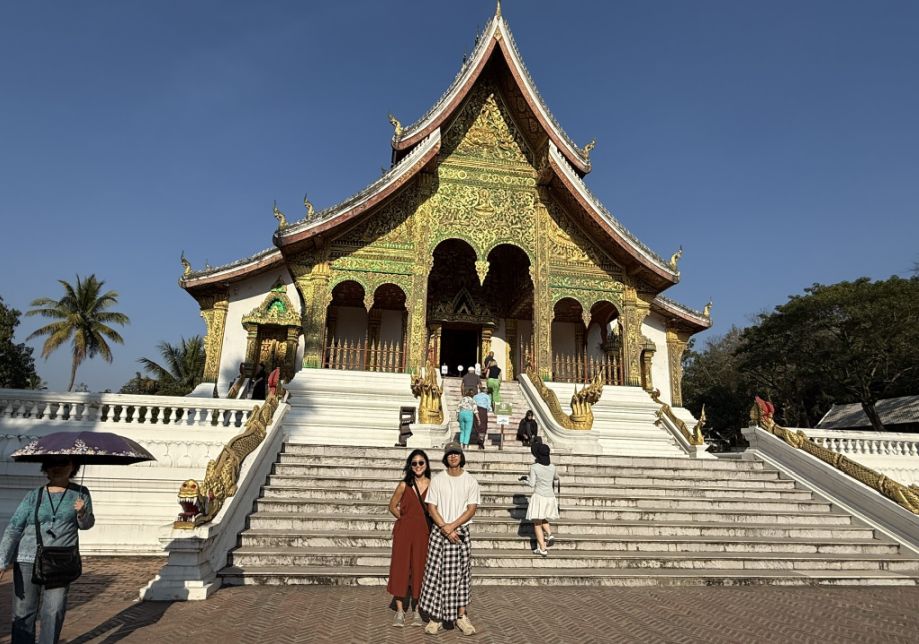
We arrived in Luang Prabang around midday, and it didn't take long before we began to understand why this small city is considered one of the most beautiful places in Laos. As we made our way through town, we passed the former Royal Palace complex, and one building immediately caught our attention.
Rising above a broad white staircase was an extraordinarily ornate temple covered in gold and green decoration, its steep, multi-tiered roof curling gracefully upward toward the brilliant blue sky. This was Haw Pha Bang, the Royal Temple of Luang Prabang.
 |
 |
At first glance, we assumed the temple must be centuries old. Surprisingly, it is quite modern. Construction began in 1963, during the monarchy, but stopped following the political changes of 1975. Work eventually resumed and the temple was completed in 2006, using traditional Lao architectural styles so successfully that it looks as though it has stood here for generations.

After visiting the Royal Palace complex, we continued walking toward the Mekong River and stopped at View Khem Khong, a small riverside restaurant with an outdoor terrace overlooking the water. The restaurant sits directly along the Mekong and is particularly known as a place to linger over a drink while watching the sunset.

By then, we were ready for a break. We settled into our seats overlooking the river and ordered fresh coconut juice, iced coffee and a wonderfully cold beer. There was no reason to hurry. We simply sat back, enjoyed our drinks and watched life along the Mekong.
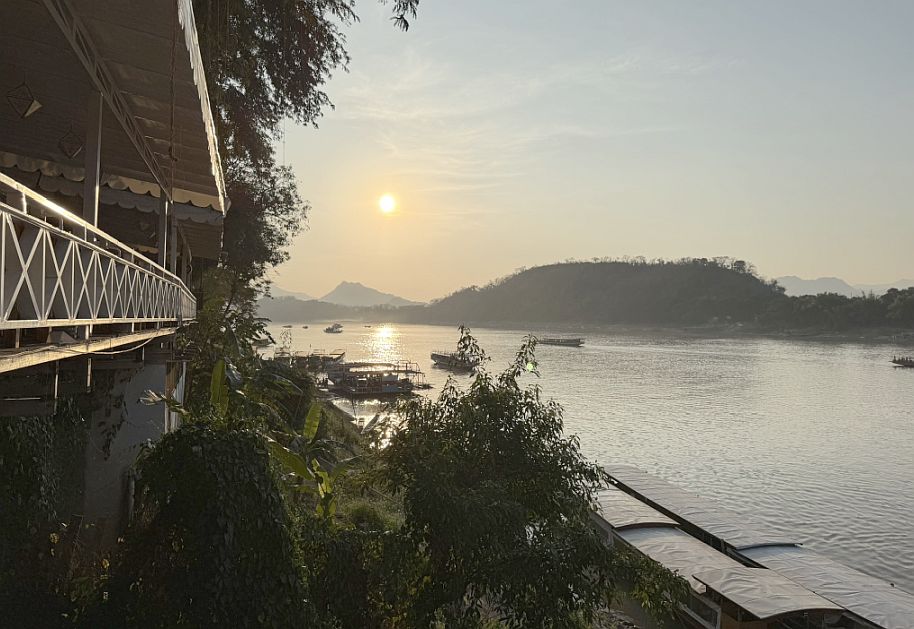
The timing couldn't have been better. The sun was beginning its slow descent, and the harsh brightness of midday gradually softened into a warm golden light. A beautiful yellow cast spread across the river, shimmering on the surface as the current moved gently below us. The distant hills and opposite riverbank seemed to soften in the late-afternoon haze.
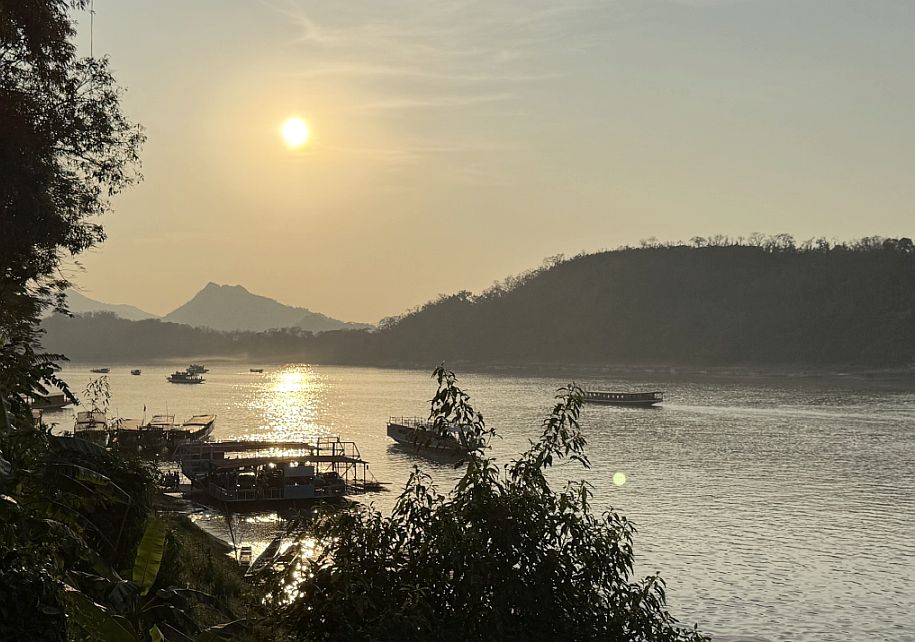
There was something wonderfully peaceful about sitting there after our first few hours exploring Luang Prabang. We had only just arrived, yet already the city seemed to be inviting us to slow down. With a cold drink in hand, the Mekong stretching out before us and the afternoon sun turning the water gold, we were perfectly content to sit for a while and simply take in the view.
Dinner at Bouang
 |
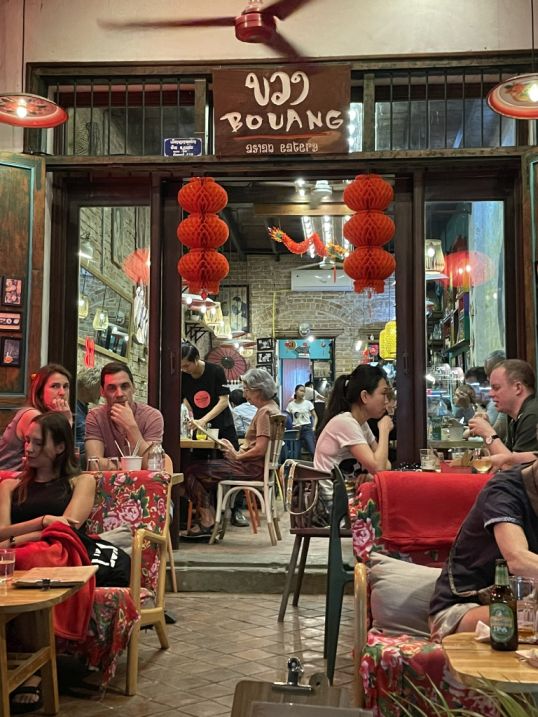 |
After dark, we headed to Bouang Asian Eatery on Rue Sisavangvong, one of Luang Prabang’s most inviting restaurants. Its vibrant red lanterns and warm, colorful décor made the place feel lively and welcoming from the moment we arrived.
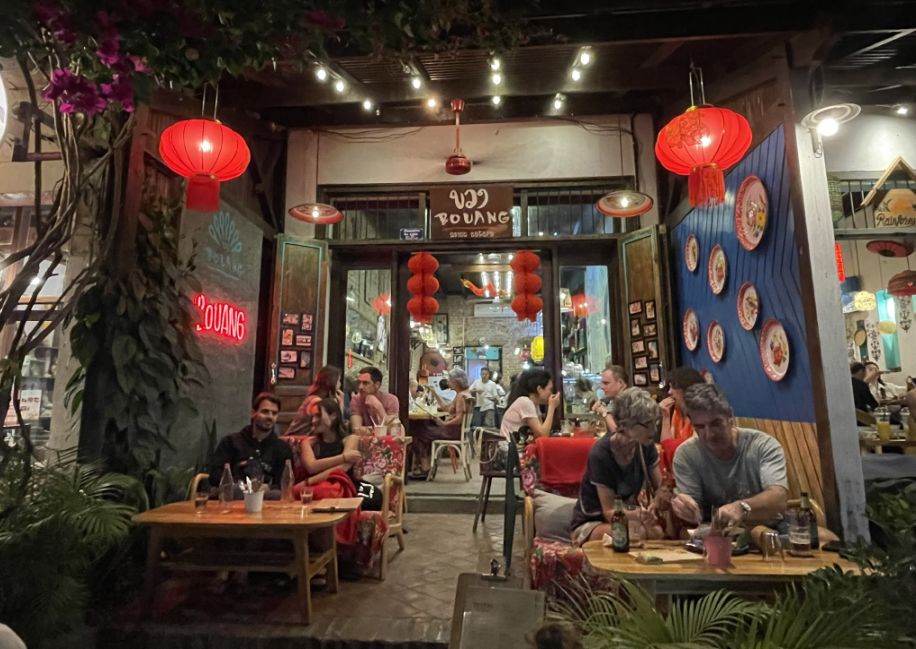
A lot of European travelers are dining here.

Bouang is known for its creative Franco-Laotian fusion cuisine, a natural reflection of Luang Prabang’s Lao and French heritage. The restaurant was reportedly founded by two young Frenchwomen. The menu combines local flavors with European influences, along with French wines, cocktails, and popular dishes such as burgers. It was clearly a favorite among visitors, and the cheerful energy made it feel like the perfect place for dinner after exploring the town.

For appetizers we ordered a plate of mango Spring roll and a fried Luang Prabang sausage that came with sticky rice.

We began our meal with a fresh and delicious mango spring roll. The sweetness and juiciness of the mango gave the appetizer a refreshing flavor, while the accompanying nuoc mam dipping sauce added a savory, salty contrast.

Our second appetizer was a Luang Prabang sausage, served with sticky rice. The plate was served on a white plate with a betel leaf. Crispy on the outside and richly seasoned inside, the sausage had a wonderful balance of herbs and spices. The betel leaf added an earthy, aromatic touch and made the presentation especially attractive.

Before moving on to a classic marguerite pizza, simple, but done so well w

For our main courses, I ordered my favorite Lao dish, nem khao, a crispy rice mixed with pork and fragrant herbs.
 |
 |
It was served with fresh lettuce and betel leaves, which we used to wrap the flavorful mixture into small, delicious bites.

Hoa ordered a smash hamburger with French fries and salad, a perfect example of Bouang’s blend of Western and Lao influences.

Kristie ordered the coconut lemongrass fish: tilapia gently cooked in coconut milk with lemongrass, lime, cherry tomatoes, fried garlic, and coriander, served with steamed rice.
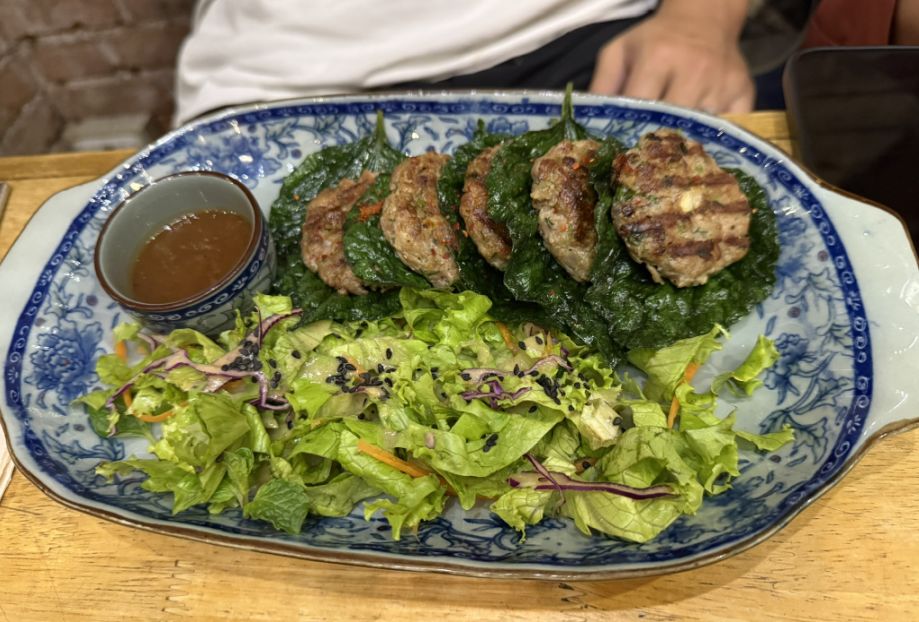
Kevin chose the grilled pork patties, which arrived as five beautifully charred patties arranged on a bed of betel leaves, alongside a fresh salad and dipping sauce. The patties looked juicy and richly seasoned.

For dessert we shared the mango sticky rice. Really delicious.

Together, our dishes created a wonderful mix of traditional Lao flavors and creative international cuisine. We are glad we stopped by here for dinner.

After dinner, we walked back to our hotel along Luang Prabang’s main street, Sisavangvong Road. At night, the street came alive under the warm glow of streetlights and storefronts.

Colorful signs, small boutiques, cafés, restaurants, and souvenir shops lined both sides of the road, while visitors wandered between them enjoying the relaxed evening atmosphere.
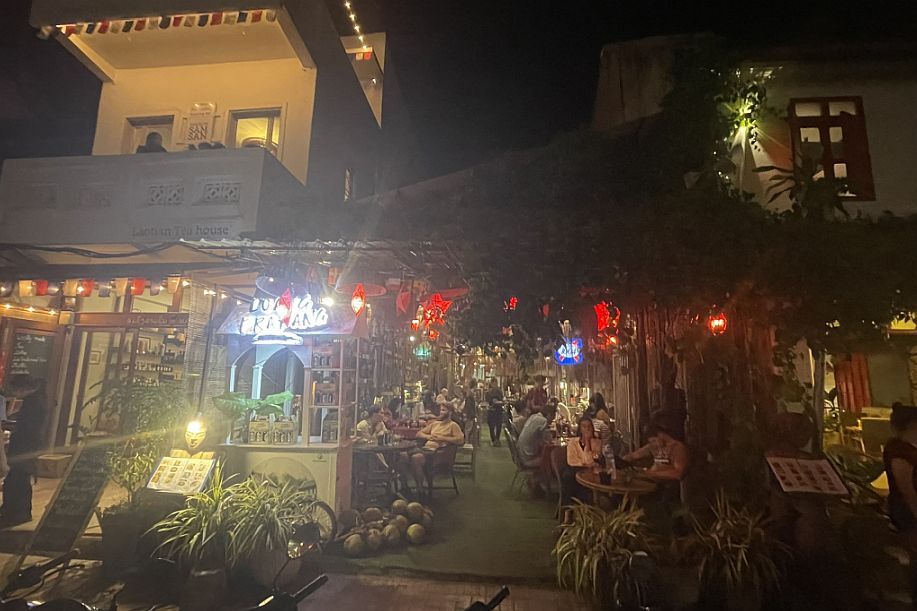
Luang Prabang has a gentle, unhurried rhythm at night, and walking through the illuminated old town with its traditional buildings, restaurants, and quiet corners, was a lovely way to end the evening.

The street was lively but never overwhelming.
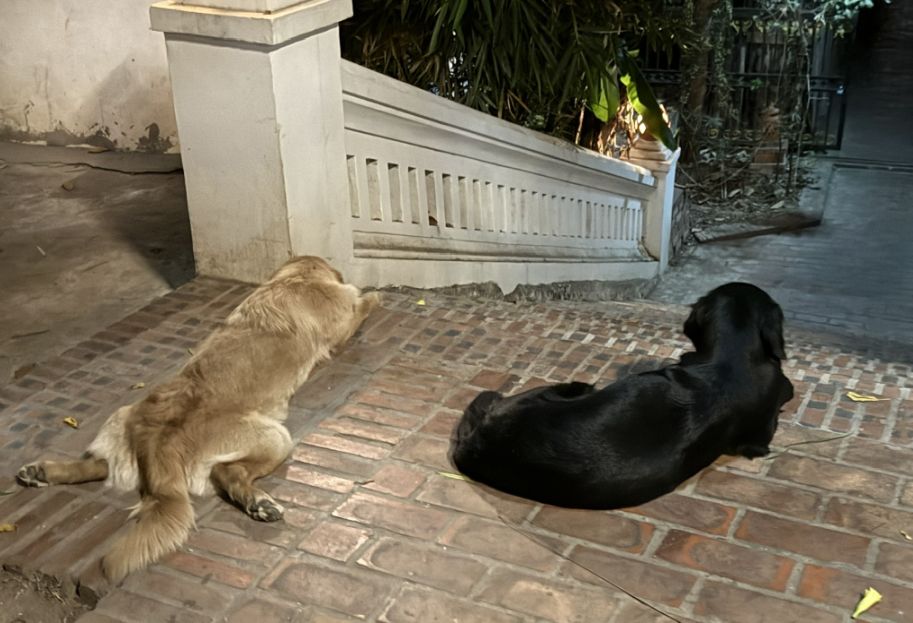
As we continued toward the hotel, we passed through the grounds of a temple and noticed several dogs resting peacefully on the cool floor. We were told that the temple helps care for stray dogs, offering them food, shelter, and a safe place to sleep.
 |
 |
The dogs seemed completely at ease as they lounged beneath the temple buildings, a gentle reminder of the compassion often associated with Buddhist communities. Amid the quiet grounds and soft evening light, the scene felt unexpectedly touching.
NEXT... Day 4-Mekong River boat cruise